Clootrack is now officially available as a ChatGPT Plugin
Install now




.webp)
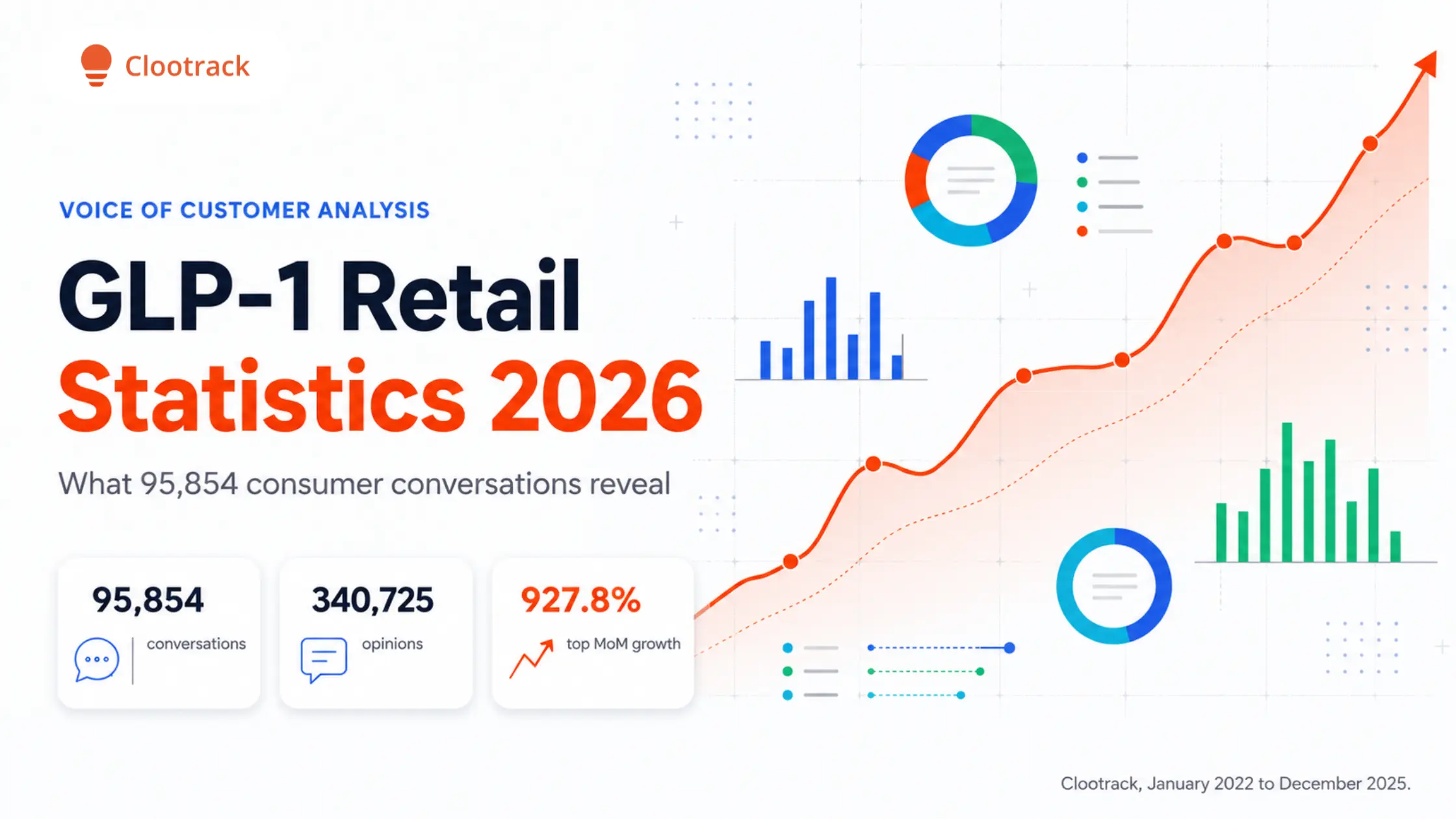
Source: Clootrack Voice of Customer analysis — 95,854 consumer conversations, 340,725 opinions, January 2022 to December 2025. Figures are directional signals from consumer conversation data, not verified sales figures.
Nobody designed GLP-1 medications to restructure grocery baskets, freeze apparel conversion, or reorganize household alcohol budgets on a biological schedule. But that is what is happening, and most retailers have no system for seeing it form. This synthesis of Clootrack's analysis of 95,854 GLP-1 consumer conversations shows how retail demand is being rebuilt in 2026, and where the commercial exposure sits.
The GLP-1 effect on retail is the structural reorganization of how, when, and why consumers buy, driven by the appetite, body, identity, and budget changes that GLP-1 medications produce rather than a simple reduction in overall spending.
In one line: Demand is not contracting. It is being resequenced around biological maintenance, capability preservation, and gradual identity recovery.
This distinction matters commercially. A transaction dashboard reads a category dip as weakness and reaches for price. The behavioral data shows the mechanism is rarely price sensitivity. It is sequencing. The same household is funding hydration, protein, and firming routines first and deferring indulgence, not abandoning it. (For the structural definition and the four purchase rhythms framework, see What is GLP-1 retail impact?)
Because transaction data records what consumers bought after behavior stabilized, while the reorganization shows up first in how consumers talk about their decisions weeks or months earlier.
Dashboards capture the outcome. They do not capture the hesitation before a purchase, the routine forming before recurring revenue, the intra-week volatility before point-of-sale fluctuation, or the identity lag before conversion declines. Intent reorganizes first. Conversation reflects the reorganization. Purchasing follows. Revenue confirms it last.
By the time a behavioral shift appears in a financial dashboard, the operational exposure is already embedded in inventory, promotional calendars, and working capital. That gap between formation and confirmation is the single most important idea in this report, and it is where 2026 retail performance will be decided.
See the exact behavioral signals forming in your own category data.

The five domains are not five separate trends. They are one structural shift expressed through five category contexts. Each maps to a distinct retail impact vector.
GLP-1 introduces a dose-driven appetite rhythm. Days 1–3 after injection bring appetite suppression and nausea sensitivity; days 4–5 stabilize; days 6–7 bring appetite return. This does not eliminate food demand, it redistributes intensity inside the week.
One consumer described it plainly: "The first 3 days after my dose, I'm buying ginger ale, crackers, and soup. The last 3 days, I'm buying real groceries. My cart looks completely different depending on where I am in my week."
The signal in the data: GI Symptoms appear in 5,084 mentions at just 9.3% positivity but 40.8% month-over-month growth, while Hydration Practices grow 99.3% MoM at 62.4% positivity. Problems skew negative; solutions skew positive and accelerate. Consumers are not just eating less, they are assembling structured side-effect management systems. The economic unit has shifted from product to system.
→ Deep dive: The GLP-1 dose calendar effect in grocery retail · Weekly demand cycle in category planning
The dominant movement signal is not ambition. It is restored access. Across 15,112 Physical Activity mentions, 63.1% are positive, and walking dominates because it requires no performance threshold, no recovery window, and no gym.
Beneath that, a second signal is accelerating: Muscle Mass Changes appear in 2,454 mentions, the only major movement theme where sentiment skews negative (38.9% positive) despite high growth (50.9% MoM).
Strength training is being framed as protection, not transformation. Protein, equipment, and wearables are converging into a preservation economy that spans categories retailers merchandise separately.
→ Deep dive: The GLP-1 preservation economy in fitness retail · Fitness and movement category demand guide
Weight loss is measurable. Identity adjustment is not. Across 6,464 body image mentions, positivity is only 48.5%, a divided psychological state, not uniform empowerment.
The result is purchase paralysis driven by size uncertainty, financial-waste perception, and identity lag.
As one shopper put it: "I went shopping three times last month and bought nothing. I don't know what size I am. I don't know what fits. I just stood there and left."
Traffic rises while conversion stalls, and price cuts do not fix psychological lag. The counter-signal is real but early: Fashion Confidence is growing 218.9% MoM, indicating the hesitation window is temporary, not permanent.
→ Deep dive: How GLP-1 is stalling apparel conversion · Body change and apparel purchase behavior
Rapid weight loss changes facial volume. The result is deflation anxiety ("Ozempic face") growing 140.3% MoM, and a beauty conversation shifting from transformation to correction.
Cosmetic Interventions are the fastest-growing theme in the entire dataset at 927.8% MoM, driven almost entirely by non-surgical solution-seeking: collagen routines, firming serums, red light therapy, microcurrent devices.
Confidence is being rebuilt through repair, not embellishment. The economic unit has shifted from decorative cosmetics to structural skin management, assembled across aisles retailers keep separate.
→ Deep dive: The GLP-1 beauty repair economy · Beauty category reallocation guide
GLP-1 households are not exiting categories. They are reorganizing budgets around a new anchor: health stability. The most significant shift is alcohol. Alcohol Intake conversations grow 81.3% MoM, with tolerance and sensitivity subthemes (331.7% and 291.8% MoM) suggesting much of the shift is physiological, not discretionary, and may not respond to promotion.
Meanwhile, consumers are reframing GLP-1 spending as a net financial positive, the Savings and Long-Term Financial Planning theme grows 349.4% MoM. The pattern is sequencing: defensive spending (GI management, protein, hydration, firmness repair) is funded first; expressive spending is deferred, not eliminated.
→ Deep dive: The GLP-1 wallet reorganization · Household spend reallocation guide
Act on formation signals before they confirm in revenue, because shelf adjacency and consumer trust claimed during the formation window become structurally resistant to displacement once routines harden.
In practice that means five priorities: align promotions to weekly appetite cycles rather than static calendars; merchandise systems instead of single SKUs; reduce size-transition friction in apparel rather than discounting it; reframe beauty around structural repair; and treat Voice of Customer intelligence as planning-grade input alongside transaction data, not as contextual color. The recalibration does not require transformation or new capital. It requires reading behavioral intent earlier than competitors.
The full role-specific playbook for Chief Commercial Officers, VP Category Management, Directors of Merchandising, and Directors of Category Insights is in the complete report: The GLP-1 Effect on U.S. Retail: What Voice of Customer Data Reveals in 2026.
No. The data indicates redistribution, not contraction. GLP-1 households reorganize budgets around health stability, funding defensive categories first and deferring expressive ones rather than spending less in total.
Five domains are reshaping simultaneously: grocery and fresh (intra-week volatility), fitness and wellness (preservation demand), apparel (conversion stall from identity lag), beauty (repair-driven reallocation), and household spending (cross-category reallocation, led by alcohol).
Transaction data records stabilized behavior after a purchase decision is made. The reorganization appears first in consumer language: hesitation, routine formation, intra-week volatility, weeks or months before it confirms in point-of-sale data.
Cosmetic interventions, growing 927.8% month-over-month in the dataset, driven almost entirely by non-surgical, repair-oriented solution-seeking in response to facial deflation.
Roughly 1 in 8 U.S. adults report current or recent use per 2025 KFF and RAND surveys, and J.P. Morgan projects approximately 25 million Americans on treatment by 2030, up from around 10 million in 2025. Oral formulations launching in 2026 are expected to accelerate penetration further.
It is structural. Adoption is still scaling, oral formulations launching in 2026 are expected to accelerate it, and the underlying change is sequencing rather than elimination. Consumers defer expressive spending behind health stability rather than abandoning categories, so the effect intensifies as penetration grows rather than fading.
Share :



Analyze customer reviews and automate market research with the fastest AI-powered customer intelligence tool.