
GLP-1 weekly demand cycle: How it reshapes grocery retail planning

Last Updated:
April 20, 2026

Reading time:
Time
mins

The GLP-1 weekly demand cycle is the predictable seven-day behavioral pattern of appetite suppression, stabilization, and normalization that follows each GLP-1 injection and restructures consumer food purchasing within the week.
For grocery and fresh food category leaders, this cycle is the operational mechanism behind a set of planning misalignments that currently surface as unexplained variance. Understanding its three phases and its tolerance filtering layer is the prerequisite for recalibrating the four planning inputs covered in this knowledge base.
TL;DR
- The GLP-1 weekly demand cycle is a seven-day behavioral pattern anchored to injection timing that produces two structurally different shopping profiles from the same consumer within one week
- Phase 1 (Days 1 to 3): appetite suppression and GI sensitivity narrow purchasing to functional categories
- Phase 2 (Days 4 to 5): partial appetite return and cautious food experimentation
- Phase 3 (Days 6 to 7): appetite normalization and full purchase intent return
- The tolerance filtering layer means GI sensitivity constrains basket composition independently of appetite, so basket size analysis alone understates the behavioral shift
- The GI stack is a coordinated weekly purchase set restocked on a pharmaceutical schedule spanning grocery, pharmacy, and wellness aisles simultaneously
- Four planning inputs need recalibration: fresh food ordering, portion format assortment, promotional timing, and cross-aisle merchandising
What is the GLP-1 weekly demand cycle?
The GLP-1 weekly demand cycle is the intra-week behavioral rhythm produced by weekly injection schedules. Each injection initiates a consistent post-dose sequence regardless of which GLP-1 medication is used or which day of the week the injection occurs.
Within Clootrack's analysis of 95,854 GLP-1 consumer conversations collected between January 2022 and December 2025, 12,725 mentions were classified under the Dosage Patterns subtheme. Consumers document injection timing, post-dose appetite shifts, and weekly grocery reorganization in consistent recurring detail across the full four-year dataset. This is not a niche behavioral pattern. It is structurally consistent across the dataset.
The cycle does not eliminate food demand. It redistributes demand intensity within the week, creating a purchasing pulse that aggregate sales models cannot detect at weekly or monthly resolution.
The three phases
Phase 1: Appetite suppression (Days 1 to 3)
Appetite suppression reduces food interest and portion tolerance. GI sensitivity operates in parallel, narrowing the categories consumers feel safe eating independently of appetite level. Purchasing narrows to a functional set: broths, plain starches, ginger-based products, hydration, and small formats. This phase produces the most significant basket composition shift of the cycle.
The tolerance filtering layer is the commercially significant nuance. A consumer with partially recovering appetite in late Phase 1 may still constrain their basket to Phase 1 safe categories because GI sensitivity has not resolved. Basket composition and basket size do not move together.
Phase 2: Stabilization (Days 4 to 5)
Partial appetite return with cautious reintroduction of foods outside the Phase 1 safe list. Portion tolerance gradually increases. This phase is the most analytically invisible. It produces neither the dramatic basket narrowing of Phase 1 nor the full purchase normalization of Phase 3, blending into weekly averages without generating a distinct signal.
Phase 3: Appetite normalization (Days 6 to 7)
Appetite returns to near-baseline. Food interest and cravings re-emerge. Consumers meal prep, stock up, and make standard grocery decisions. This is the highest purchase-intent window in the weekly cycle. A promotional offer reaching this consumer in Phase 3 reaches a fundamentally different intent state than the same offer in Phase 1.
Why standard planning cannot see this
Two foundational planning assumptions break down under the GLP-1 weekly demand cycle.
1. Demand is stable within the week
Weekly and monthly aggregate models are built for environments where intra-week variability comes from day-of-week patterns and promotional lift. The GLP-1 cycle introduces pharmaceutical timing as a third source of intra-week variability; predictable when injection timing is understood, invisible when smoothed into weekly averages.
2. The same household has consistent weekly needs
A GLP-1 household generates a Phase 1 functional basket and a Phase 3 standard basket within the same seven days. Category-level demand averaging treats both as a single weekly signal, which produces four planning problems:
- Fresh shrink increases because fresh food ordered for mid-week arrives during a Phase 1 suppression window when consumers are not buying perishables at normal volume.
- Promotional performance drops because volume deals and hearty meal promotions landing in Phase 1 reach a consumer who is physically unable to act on them, not a consumer who is uninterested.
- Labor gets misallocated because staffing is built on historical traffic patterns that do not account for Phase 3 being the true high-purchase window.
- Category diagnostics mislead because Phase 1 slowdowns get read as demand exit or assortment failure. The consumer will be back buying the same category in Phase 3.
The GI stack economy
Inside the Phase 1 suppression window, GLP-1 consumers assemble a structured weekly purchase set that functions as a coordinated symptom management system.
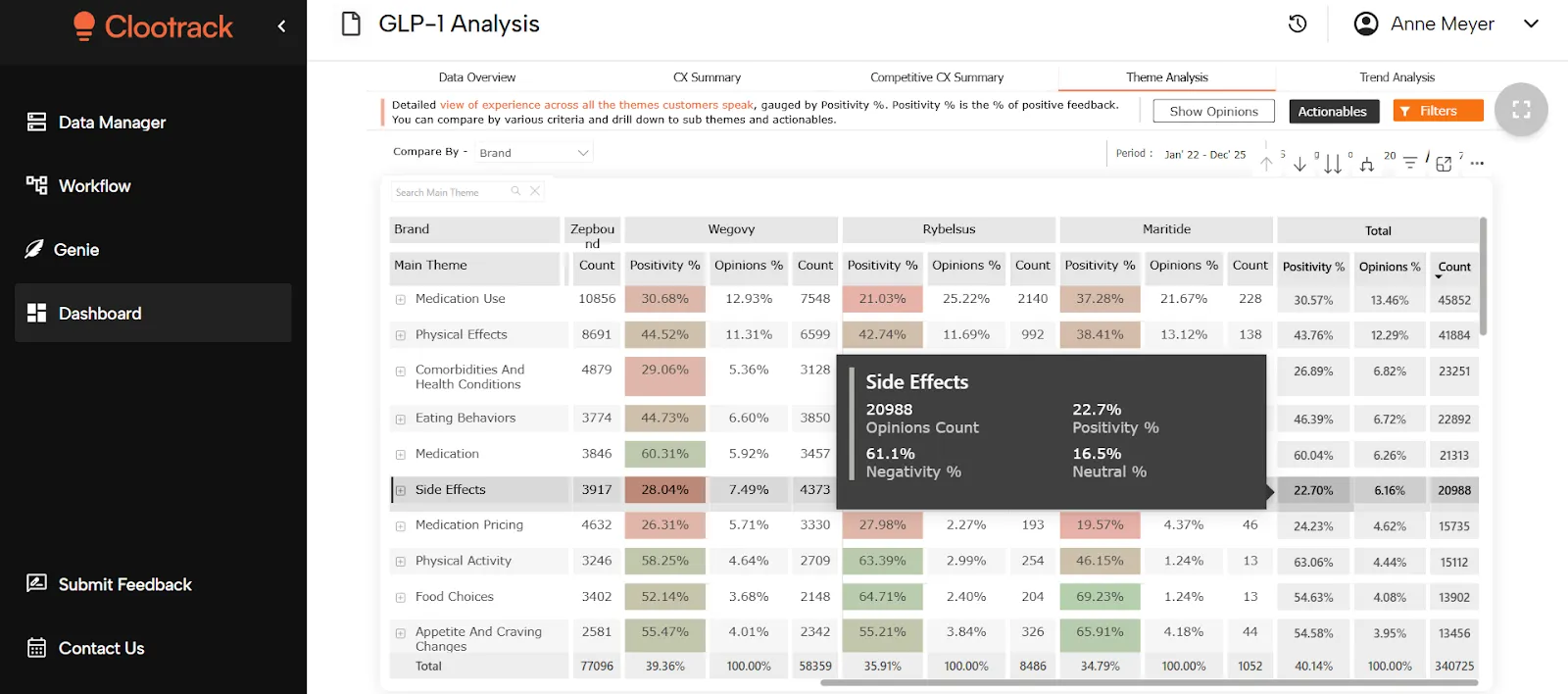
The sentiment asymmetry is the signal. GI Symptoms at 9.3% positivity confirms the problem is real and widespread. Side Effects Management at 57.9% positivity confirms consumers have found effective solutions. Hydration conversations at 99.3% MoM growth confirms hydration has become a core weekly management behavior.
This stack (hydration, ginger, electrolytes, OTC relief, gentle starches) restocks every seven days on a pharmaceutical schedule independent of promotions. Its components span grocery, pharmacy, and wellness aisles simultaneously.
Planning recalibration framework
The cycle does not require new infrastructure. It requires recalibrating four existing planning inputs.
1. Fresh food ordering
Mid-week fresh orders in GLP-1 penetrated markets should account for Phase 1 suppression in volume forecasting. Late-week orders may need upward adjustment for Phase 3 recovery.
2. Portion format assortment
Phase 1 consumers need single-serve and small formats. Phase 3 consumers return to standard formats. Format breadth across both states is the correct assortment response.
3. Promotional timing
Volume promotions, hearty proteins, and meal occasion bundles perform better timed to Phase 3 windows. GI-friendly foods, hydration, and comfort formats should be consistently available through Phase 1. Static weekly promotional calendars that treat all days equivalently are not calibrated for this consumer.
4. Cross-aisle GI stack visibility
The stack is currently self-assembled by consumers across unconnected aisles. Retailers who create coordinated cross-aisle visibility for the full GI stack reduce assembly friction and increase full-stack trip completion.
For the broader commercial analysis, see the GLP-1 retail impact report.
FAQs
What is the GLP-1 weekly demand cycle?
A predictable seven-day pattern of appetite suppression, stabilization, and normalization following each GLP-1 injection. It produces two structurally different shopping profiles from the same consumer within a single week: a narrow functional basket early in the week and a standard grocery basket when appetite returns late in the week.
How does the GLP-1 injection cycle affect grocery purchasing?
It creates intra-week demand volatility that weekly sales averages smooth into a flat signal. The same household generates a suppression-phase basket early in the week (narrow, functional, GI-friendly) and a normal grocery basket late in the week when appetite normalizes. Standard planning models treat both as one signal.
What is the tolerance filtering layer?
GI sensitivity constrains basket composition independently of appetite level. A consumer with partially recovering appetite may still purchase only gentle, GI-safe categories because digestive discomfort has not yet resolved. Basket composition and basket size do not move together, so basket size analysis alone understates the behavioral shift.
What is the GLP-1 GI stack?
A coordinated weekly purchase set of hydration, ginger, electrolytes, OTC relief, and gentle foods assembled to manage injection-related GI side effects. It restocks on a pharmaceutical schedule independent of promotions and spans grocery, pharmacy, and wellness aisles simultaneously.
How should retailers recalibrate planning for the GLP-1 demand cycle?
Four inputs require recalibration: fresh food ordering volume adjusted for the early-week suppression window, portion format assortment expanded to cover both small suppression-phase formats and standard late-week formats, promotional timing sequenced to late-week appetite windows, and cross-aisle visibility coordinated across GI stack components.
Is the GLP-1 weekly demand cycle detectable before it appears in sales data?
Yes. Consumer conversations about injection timing, GI symptom management, and weekly grocery planning all appear in VoC data before they stabilize into purchase patterns. The behavioral shift announces itself in language before it confirms in transactions, which is why Voice of Customer analytics surfaces this cycle earlier than point-of-sale metrics can.
Share :



Do you know what your customers really want?
Analyze customer reviews and automate market research with the fastest AI-powered customer intelligence tool.