
What is GLP-1 retail impact? How Voice of Customer analytics detects demand shifts before transaction data

Last Updated:
April 8, 2026

Reading time:
Time
mins
GLP-1 retail impact is the structural reorganization of consumer purchasing behavior across grocery, apparel, beauty, fitness, and household spending that results from GLP-1 medication use at population scale.
GLP-1 medications have moved from a clinical intervention to a mass-market behavioral variable embedded within the existing retail customer base across every major U.S. demographic.
For retail leaders, the challenge is not recognizing that adoption is scaling. It is understanding that the behavioral changes GLP-1 produces are structurally different from anything historical purchase data has encountered. Weekly forecasting models, monthly category reviews, and conversion metrics built on decades of stable consumer behavior are running on assumptions that GLP-1 adoption is actively invalidating.
This knowledge base defines GLP-1 retail impact as an operational framework, explains why conventional analytics cannot detect it, and maps the five behavioral domains through which it operates.
TL;DR
What is GLP-1 retail impact? A structural reorganization of consumer purchasing behavior across grocery, fitness, apparel, beauty, and household spending, driven by the biological and psychological effects of GLP-1 medication use at scale.
Why does it matter for retail planning? These behavioral shifts form in consumer language before they appear in transaction data. Organizations acting solely on sales data are detecting the change after the window to respond proactively has narrowed.
What are the five domains? Consumption Shifts, Activity Patterns, Apparel Behavior, Appearance Anxiety, and Spend Reallocation. Each is a distinct operational signal with specific commercial consequences.
How is it detected? Through Voice of Customer analytics, analysis of unsolicited consumer conversations at scale, which surfaces behavioral intent before it stabilizes into purchase patterns.
What is the cost of not acting? Measurement lag. Financial dashboards confirm behavioral shifts only after they have embedded in consumer habit. Competitor positions are established during the formation window that precedes that confirmation.
What is GLP-1 retail impact?
At current and projected adoption levels, GLP-1 simultaneously affects how consumers shop for food, how they engage with fitness, how they approach apparel, how they spend on beauty, and how they allocate household budgets.
This is not a niche health trend or a single-category phenomenon. It is structurally different from previous demand shifts in three ways.
1. It is biologically anchored.
Appetite timing, food tolerance, physical capability, and psychological identity perception all shift in predictable sequences tied to dosing cycles. No historical retail dataset has captured this variable and no conventional forecasting model is currently weighting it.
2. It operates across category boundaries simultaneously.
A single GLP-1 user generates behavioral changes in grocery, fitness, apparel, beauty, and household spending at the same time. Siloed category analytics cannot see the full pattern because it is distributed across traditional category boundaries.
3. It reorganizes spending rather than contracting it.
When a demand signal softens, the standard assumption is that consumers are spending less. GLP-1 influenced households are redirecting budgets toward health stability as a new priority anchor. The exit from some categories funds the entry into others. Retailers operating only on one side of that flow will misread the signal.
Why transaction data cannot see it
Transaction data records the final act of a consumer decision. It does not capture the extended period of intention, hesitation, routine formation, and spending reorganization that precedes the purchase.
Voice of Customer analytics operates in that preceding period. It analyzes unsolicited consumer conversations across forums, social media, and review sites, where consumers narrate behavioral changes, product substitutions, and spending adjustments in real time.
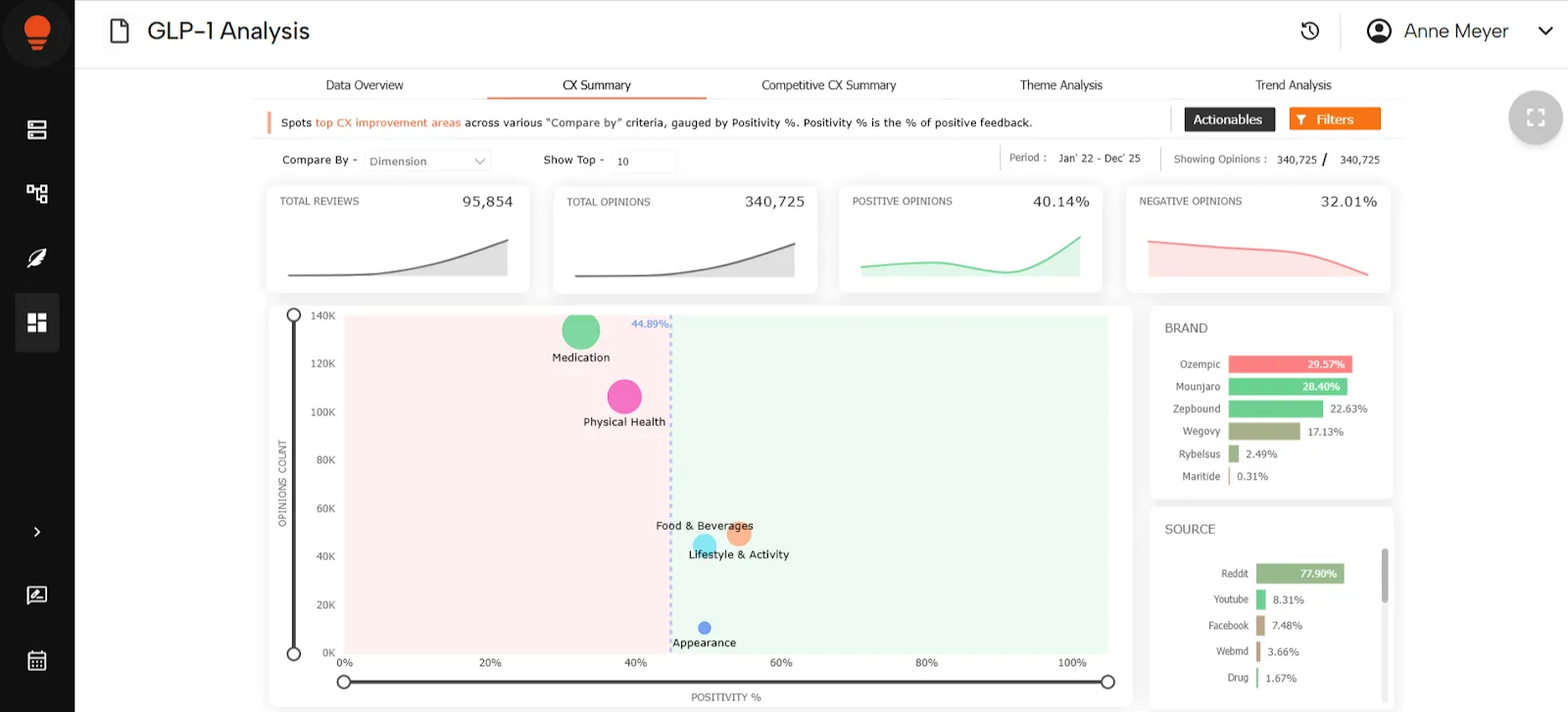
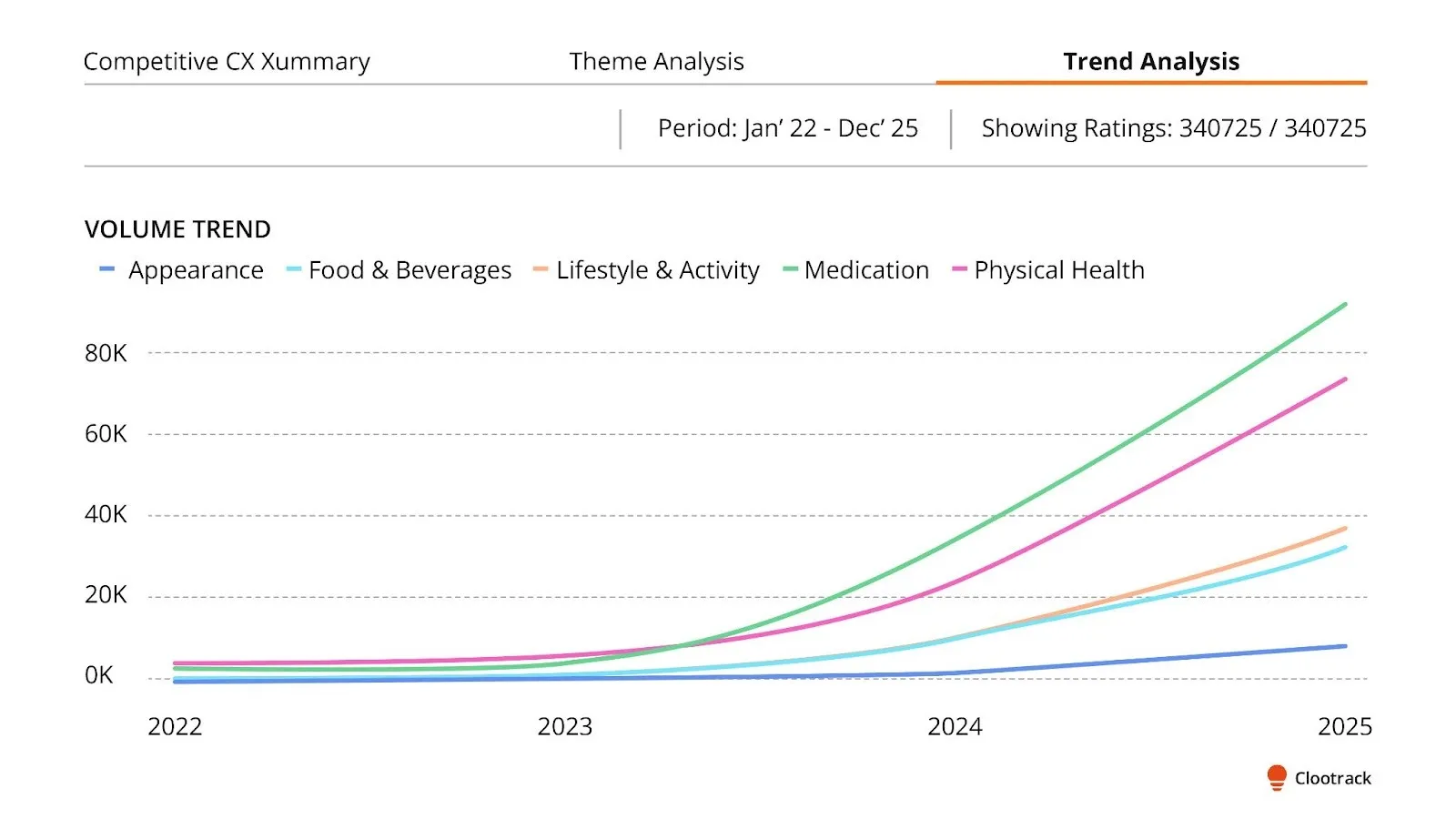
Clootrack analyzed 95,854 GLP-1 consumer conversations collected between January 2022 and December 2025, extracting 340,725 opinions using patented unsupervised AI thematic detection at 98% analysis accuracy. The analysis operates at the opinion level rather than the conversation level, a single consumer post may contain distinct opinions across appetite changes, grocery adjustments, fitness engagement, body image, and budget reallocation simultaneously.
Three signal types surface that transaction data cannot detect.
Sentiment asymmetry occurs when negative sentiment in a problem theme pairs with positive sentiment and high growth in a related solution theme. The gap between the two is the signal, mitigation demand forming before it reaches any sales metric.
Formation signals are themes with low current volume but accelerating month-over-month growth. Shelf positioning decisions made at sales velocity will lag behind organizations that detected the pattern during formation.
Cross-dimensional clustering occurs when themes across separate analytical dimensions consistently appear together in consumer conversations, indicating system-building behavior. Consumers assembling multi-product routines across aisles appear as unrelated SKU movements in siloed category reporting.
The five demand domains
The dataset produced five recurring behavioral domains. Each is a distinct mechanism, not a lifestyle observation, with measurable commercial consequences for specific retail verticals.
Domain 1: Consumption Shifts
GLP-1 injection cycles create a predictable demand pulse inside every week. Early-week appetite suppression narrows food purchasing to functional categories. Late-week normalization restores standard purchase intent. Weekly forecasting models aggregate this volatility into a flat signal, creating fresh shrink, markdown waste, and promotional ROI leakage that surfaces as unexplained variance. Understanding the GLP-1 weekly demand cycle in retail category planning is the starting point for grocery and fresh category recalibration.
Domain 2: Activity Patterns
Weight reduction restores physical capability consumers describe in the language of return, not transformation. Simultaneously, rapid weight loss generates muscle loss anxiety, the only major movement theme where sentiment is negative despite high growth. GLP-1 fitness and movement category demand splits into two distinct signals that require two distinct commercial responses.
Domain 3: Apparel Behavior
Physical body change and psychological identity adjustment do not occur at the same speed. Consumers use fitting rooms to verify that change has occurred rather than to replace wardrobes. Traffic rises, conversion softens, and the standard diagnosis of assortment weakness is incorrect. The full picture of how GLP-1 affects apparel purchase behavior shows why discounting cannot fix this conversion gap.
Domain 4: Appearance Anxiety
Rapid weight loss produces facial volume changes that shift beauty spending from aspiration toward structural skin repair. Consumers independently assemble corrective routines across categories that retail does not merchandise as systems. GLP-1 beauty category reallocation is the fastest-growing signal in the appearance domain and the most commercially misread.
Domain 5: Spend Reallocation
GLP-1 households reorganize budgets around health stability rather than contracting overall spending. Defensive health categories are funded first. Expressive discretionary categories are deferred, not eliminated. The full substitution map of how GLP-1 reshapes household spending priorities shows which categories are losing share and which are gaining it.
How to apply this framework
The five domain framework is a diagnostic tool. Use it in four steps.
Step 1: Identify domain exposure.
Which domains affect your category? Grocery faces Domains 1 and 5. Footwear and apparel faces Domain 3. Beauty faces Domain 4. Fitness faces Domain 2. Most retailers face more than one simultaneously.
Step 2: Read the signal type correctly.
Sentiment asymmetry indicates mitigation demand. High growth at low volume indicates formation-stage patterns. Cross-dimensional co-mentions indicate system-building behavior. Each requires a different commercial response.
Step 3: Recalibrate planning inputs.
These domains do not require new capital. They require behavioral intelligence as a planning input alongside transactional data, applied to forecasting granularity, category adjacency design, promotional timing, and conversion strategy.
Step 4: Act during formation, not confirmation.
Behavioral formation precedes revenue confirmation in every domain. Shelf adjacency established during formation becomes structurally resistant to displacement once consumer routines solidify.
The full analytical evidence behind each domain is available in the GLP-1 retail impact report.
FAQs
What is GLP-1 retail impact?
GLP-1 retail impact is the structural reorganization of consumer purchasing behavior that results from GLP-1 medication use at population scale. Unlike previous demand shifts driven by economic or seasonal factors, it is biologically anchored, cross-category, and reorganizes spending rather than contracting it.
How does GLP-1 affect retail sales?
GLP-1 does not uniformly reduce retail sales. It redistributes demand across the week through injection cycle volatility, across categories through system-building and substitution flows, and across time through a gap between behavioral formation and revenue confirmation.
Which retail categories are most affected by GLP-1?
All five major retail verticals are affected through distinct mechanisms. Grocery faces intra-week demand volatility and GI stack formation. Fitness faces a shift from performance to preservation demand. Apparel faces identity lag suppressing conversion despite rising traffic. Beauty faces a reallocation from aspiration to corrective repair. Mass retail faces cross-category budget reorganization.
How can retailers detect GLP-1 demand shifts before they appear in sales data?
Voice of Customer analytics surfaces behavioral formation signals before they stabilize into purchase patterns. The three primary signal types are sentiment asymmetry, formation-stage growth clusters, and cross-dimensional co-mention patterns.
What is the measurement gap in GLP-1 retail planning?
The measurement gap is the delay between when behavioral formation occurs in consumer language and when it confirms in financial dashboards. Retailers operating solely on transaction data detect the shift after behavioral patterns have hardened, competitor positions have been established, and operational costs of misalignment have been absorbed.
Is GLP-1 retail impact a short-term trend or a structural shift?
It is structural. Oral formulation availability in 2026 removes the primary adoption barrier. Consumer routines formed during the current adoption phase resist displacement once established. The biological anchoring, cross-category system building, and health-first budget reorganization that characterize this shift intensify as adoption scales.
Share :



Do you know what your customers really want?
Analyze customer reviews and automate market research with the fastest AI-powered customer intelligence tool.