


VoC Analysis Report
The GLP-1 preservation economy in fitness retail
GLP-1 weight loss has created a preservation economy inside fitness retail, and it looks nothing like the aspiration-driven demand the category was built around.
Consumer motivation segmentation
This analysis maps consumer motivation across 95,854 GLP-1 consumer conversations using unsupervised AI thematic detection. Not overall fitness growth but actual demand signal separation revealing which product clusters are capturing preservation demand versus aspiration demand.
15,112
Physical activity mentions
4 Years
Analysis window
U.S.
Market
Executive summary
GLP-1 weight loss has unlocked physical capability for millions of consumers. Walking again, using stairs without pain, resuming activities abandoned years earlier. The language is consistently about restored access, not fitness achievement. This is the first demand signal: capability restoration driving entry-level movement behavior.
Beneath it, a second signal is accelerating in the opposite direction. Muscle Mass Changes is the only major movement theme in the dataset where sentiment is negative despite high growth. Consumers are not inspired by muscle building. They are anxious about losing muscle as a side effect of rapid weight reduction. Strength training is framed as protection, not transformation.
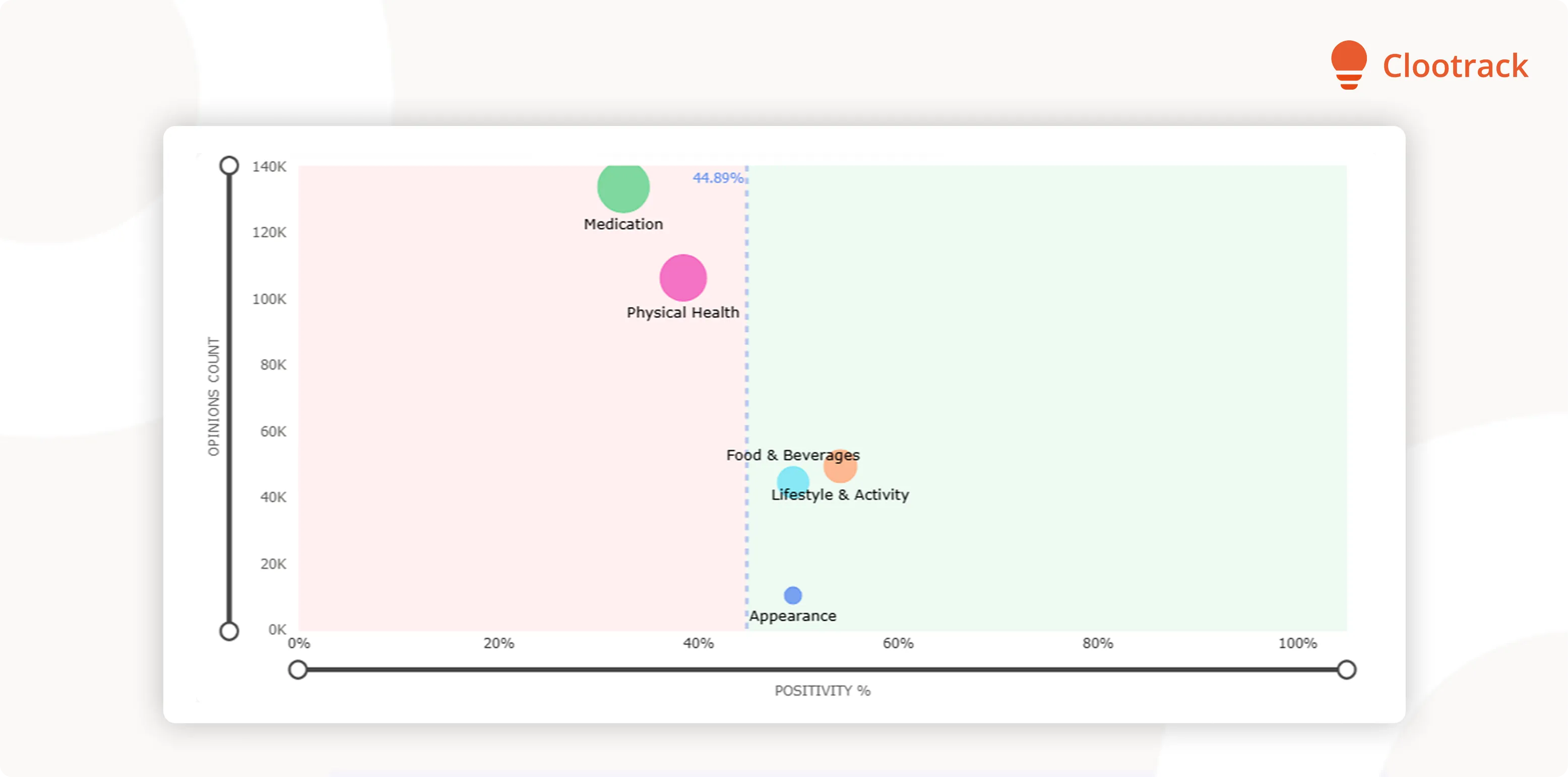
Lifestyle and Activity sitting above the dataset positivity average at meaningful scale. The preservation economy signal is broad-based, not a fringe pattern.
These are two distinct demand signals inside the same category. Category management that treats them as one fitness growth trend serves neither consumer effectively. The full analysis of which product clusters each signal is driving is in the report.
Key findings
1
The fitness category is growing for the wrong reason.
Muscle Mass Changes at 38.9% positive sentiment and 50.9% MoM growth is the only major movement theme where sentiment skews negative despite high growth. Anxiety is driving demand, not aspiration, and the two require completely different commercial responses.
2
Walking is the dominant activity signal, not the gym.
Walking Routines at 78.4% positive sentiment and 41.2% MoM growth leads because it requires no performance threshold, no recovery window, and no membership. Entry-level walking footwear and accessories sit in the demand cluster that is actually growing.
3
Wearables have become validation devices, not motivation tools.
Activity Tracking at 73.1% positive sentiment and 41.2% MoM growth confirms consumers are using trackers to confirm restored capability rather than push toward performance goals. The purchase motivation is reassurance, not optimization.
4
Protein demand and muscle anxiety are co-accelerating.
Protein Foods at 57.5% positive sentiment and 66.2% MoM growth and Muscle Mass Changes at 50.9% MoM growth are growing concurrently within the same consumer. The preservation system spans food, equipment, and tracking simultaneously.
Download Report
Thank you! Your submission has been received!
Oops! Something went wrong while submitting the form.
See where the preservation economy is forming before it confirms in sales data.
The full GLP-1 fitness demand analysis is in the report.
Insights report for CX, Ecommerce, Merchandising & Consumer Insights Leaders