



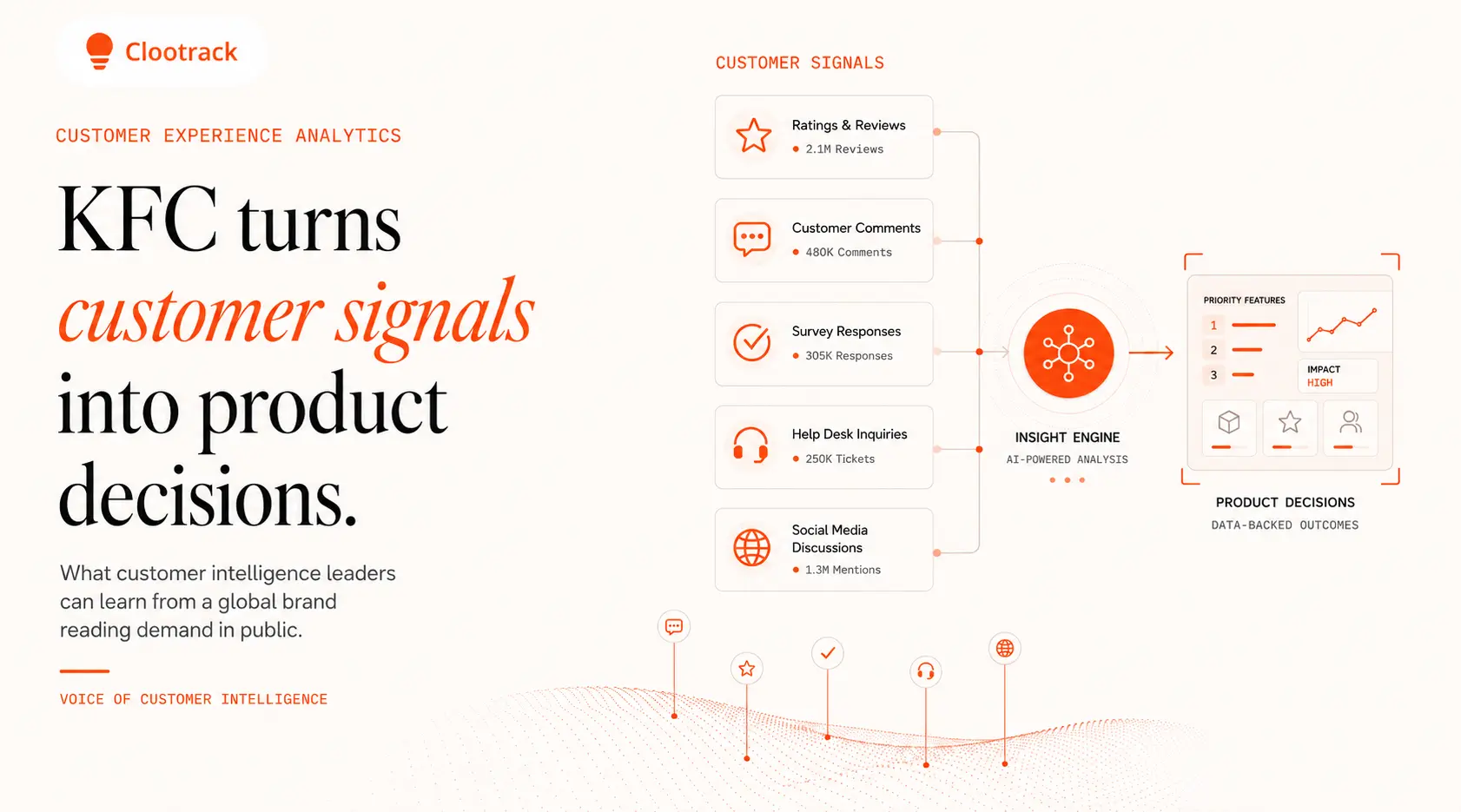
KFC's product strategy turns customer signals into product decisions. Rather than betting on intuition, the brand reads demand from reviews, social conversation, and sales data, then reinstates proven favorites, adapts by market, and rebuilds around value. For customer intelligence and product leaders, it is a working model of feedback-led decision making at global scale.
A product strategy is the long-term plan for what a company builds and for whom. A customer-led product strategy grounds those choices in analyzed customer signals rather than intuition, aligning every decision with real demand instead of internal assumptions.
KFC is a useful case in exactly that skill. After a stretch of soft U.S. sales, the brand stopped guessing and started listening, then rebuilt its menu around what customers actually asked for. The lesson lives in the decision discipline, not the menu.
This analysis looks past the food. It focuses on how a global brand reads demand, closes perception gaps, and prices for the moment, and what teams responsible for consumer insight, experience, and product can take from it.
KFC's product strategy protects a clear core identity while adapting around it through localization, value, and feedback-led decisions. The brand operates more than 30,000 restaurants across 150 countries and territories and represents roughly half of Yum! Brands' divisional operating profit. At that scale, product decisions cannot be reckless, so the strategy favors calculated bets: protect what customers already value, then extend into adjacent choices that deepen the reasons to visit.
The current chapter reframes the whole posture. After a difficult period in the United States under prior leadership, KFC shifted from pushing new concepts outward to pulling signals inward from its customers. That move, from guessing to listening, is the throughline of everything below, and it is the part worth studying regardless of category.
For any product organization, the takeaway is that scale raises the cost of a wrong bet, which makes the quality of your customer signal the real constraint on how boldly you can move.
KFC increasingly treats customer feedback as its primary product input, reading demand before it commits. Its 2025 recovery leaned on reinstating discontinued favorites, such as the 2025 return of its Original Honey BBQ sauce, that customers had spent years requesting through social conversation and petitions. Catherine Tan-Gillespie, President of KFC U.S., framed those returns plainly as turning feedback into action.
The strategic point is not the individual items. It is that latent demand was already visible in customer signals, and the brand chose to read it rather than override it. Reinstating a proven favorite is a lower-risk decision than launching an unproven one, and the evidence to make that call already existed in what customers were saying.
This is where product strategy meets product experience insights. For a customer intelligence leader, the model is repeatable. Unstructured feedback across reviews, social posts, and support conversations is a demand backlog waiting to be read. Routing that signal through contact center intelligence and Voice of Customer analytics lets a team surface demand before a competitor does, then prioritize by evidence instead of instinct.
KFC's recovery targeted a perception problem its own research exposed, not a product deficiency. Behind the 2025 campaign, brand research found that a large majority of non-customers, about 90%, still held positive feelings toward KFC even while perceiving it as outdated. That is a precise, fixable gap: the affection existed, the recency did not.
The response addressed perception directly. KFC relaunched its founder as the face of the reset and shifted the brand's tone to signal seriousness about winning customers back. Consumer mood reinforced the timing, since the National Restaurant Association's 2026 What's Hot Culinary Forecast, published in November 2025, named nostalgia, comfort, and value as the desires defining the year.
For consumer insights leaders, this is the more important lesson than any menu move. Perception and reality routinely diverge, and only customer intelligence reveals the gap between them. When goodwill is intact but relevance has slipped, the fix is a perception strategy, not a product overhaul. The strongest customer-centric companies treat that distinction as a measurable, addressable problem rather than a branding hunch.
KFC treats localization as a market-level product strategy, designing distinct assortments around local demand rather than translating one menu. In markets where vegetarianism is widespread, it builds vegetarian choices into the core menu instead of bolting them on. In others, it engineers products around local occasions and cultural moments that have no global equivalent.
The principle for a category or merchandising leader is that identical assortments across markets signal translation, while distinct assortments signal real localization. Each market carries its own demand curve, and the brands that win read it market by market.
That reading is a retail intelligence discipline as much as a culinary one. Understanding how taste, price sensitivity, and cultural occasions differ across markets is the work of retail and brand intelligence. Leaders who localize well are not guessing at regional preferences. They are measuring them, then designing assortment around what the evidence shows customers in each market actually want.
KFC is rebuilding value into its product strategy because price sensitivity now decides where people eat. According to the National Restaurant Association's 2026 State of the Restaurant Industry report, 81% of consumers say access to daily specials or promotions influences where they eat, and 60% of operators saw softer customer traffic in 2025. That environment rewards products designed as value, not discounts layered onto a fixed menu.
KFC answered with value-led bundles and offers built for a price-conscious moment, treating price and product as one decision rather than two.
For a product or marketing leader, that distinction matters. A strong product still underperforms if the value signal is read wrong, and what makes a bundle feel like value is a behavioral question, not a spreadsheet one. Grounding those calls in consumer behavior analysis, and in established psychological pricing strategies, is what separates a real value strategy from a margin giveaway.
KFC uses its owned digital channels as a product-learning system, not just a sales channel. Parent company Yum! Brands reported that digital reached nearly 60% of system sales across its brands in the fourth quarter of 2025, supported by its proprietary Byte by Yum! technology, an AI-driven platform in use across 25,000 restaurants systemwide.
That infrastructure returns something more valuable than transactions. First-party apps and ordering let the brand see what sells, to whom, and in what combinations, without surrendering the data layer to third-party aggregators. Owning that layer is what makes fast, evidence-based product decisions possible.
For any leader building a digital channel, the implication is direct. The channel's real value is the customer signal it returns, and turning that behavioral data into decisions is the job of actionable consumer insights. Teams that treat digital as a listening system, not only a convenience, compound an advantage every quarter.
The core lesson is to translate a single customer signal into a different action for each function. What matters most is that the signal, drawn from reviews, social conversation, feedback, and sales data together, becomes the primary input to product decisions rather than an afterthought. The reason KFC needed the reset is the risk any brand runs when it stops listening: drift from what customers value, and a competitor reads the demand you ignored.
What to do next depends on the role. Product leaders should build a system that converts unstructured feedback into a prioritized launch backlog. Category and merchandising leaders should read demand by market and occasion before assortment decisions. Marketing leaders should close the perception gaps the data reveals, separating goodwill from relevance. CX and insights leaders should fix the experience issues feedback surfaces before amplifying demand, since operational gains, not slogans, are what make a recovery credible.
The strength of those calls comes from combining data types rather than trusting one stream. Benchmarking each move against rivals is where competitive benchmarking earns its place, and mapping demand across every customer touchpoint is what turns scattered signals into a strategy a leadership team can act on.
KFC's product strategy is a lesson in discipline, not nostalgia. Its recovery came from treating customer signals as the primary input to what it builds, reinstates, and prices, rather than trusting intuition. For customer intelligence, product, and category leaders, the takeaway is direct. The teams that turn feedback into decisions out-innovate the ones that guess. Build the listening system first, then act on what it tells you.
KFC's product strategy protects a clear core identity while adapting around it through localized menus, feedback-driven decisions, and value bundles. Its current focus is winning customers back by reinstating items they request and closing the gap between goodwill and relevance, using customer signals as the primary input to what it builds.
Scott Mezvinsky has led the KFC Division as Chief Executive Officer since March 1, 2025, reporting to Yum! Brands CEO David Gibbs. He succeeded Sabir Sami and joined from Taco Bell, where he helped build a $20 billion brand. Catherine Tan-Gillespie serves as President of KFC U.S.
KFC treats customer feedback as a product signal, tracking social demand, petitions, and satisfaction data to decide what to build or reinstate. Rather than validating decisions after the fact, it reads latent demand first, which lowers launch risk and signals to customers that the brand is listening and acting.
KFC localizes by designing distinct assortments for each market rather than translating one global menu. It adapts to regional taste, dietary norms, and cultural occasions, treating every market as its own product strategy with its own demand curve. This raises relevance and drives repeat visits in markets that look nothing alike.
The main lesson is to make analyzed customer signals the primary input to product decisions, not a final validation step. KFC reads demand before launching, separates brand goodwill from relevance, and prices for behavior. Leaders who build that listening system into their process out-decide those relying on intuition.
KFC competes through category depth and heritage, while rivals like McDonald's compete through breadth and systematized value, and challengers like Popeyes and Raising Cane's compete on focus. KFC's advantage is its specialist identity and founder story. Its challenge is matching the pricing consistency and scale of larger rivals.
KFC launched its comeback to reverse U.S. sales declines and close a perception gap its research revealed, not to fix the product itself. The campaign paired a feedback-led menu approach with a brand reset, asking customers to try the food again and help shape the menu through direct input.
Data is central. KFC uses owned digital channels and its parent's technology platform to see what sells, to whom, and in what combinations, then feeds that behavioral signal back into product decisions. Owning the first-party data layer is what lets the brand act on demand quickly and by evidence.
Share :



Analyze customer reviews and automate market research with the fastest AI-powered customer intelligence tool.
.webp)
