


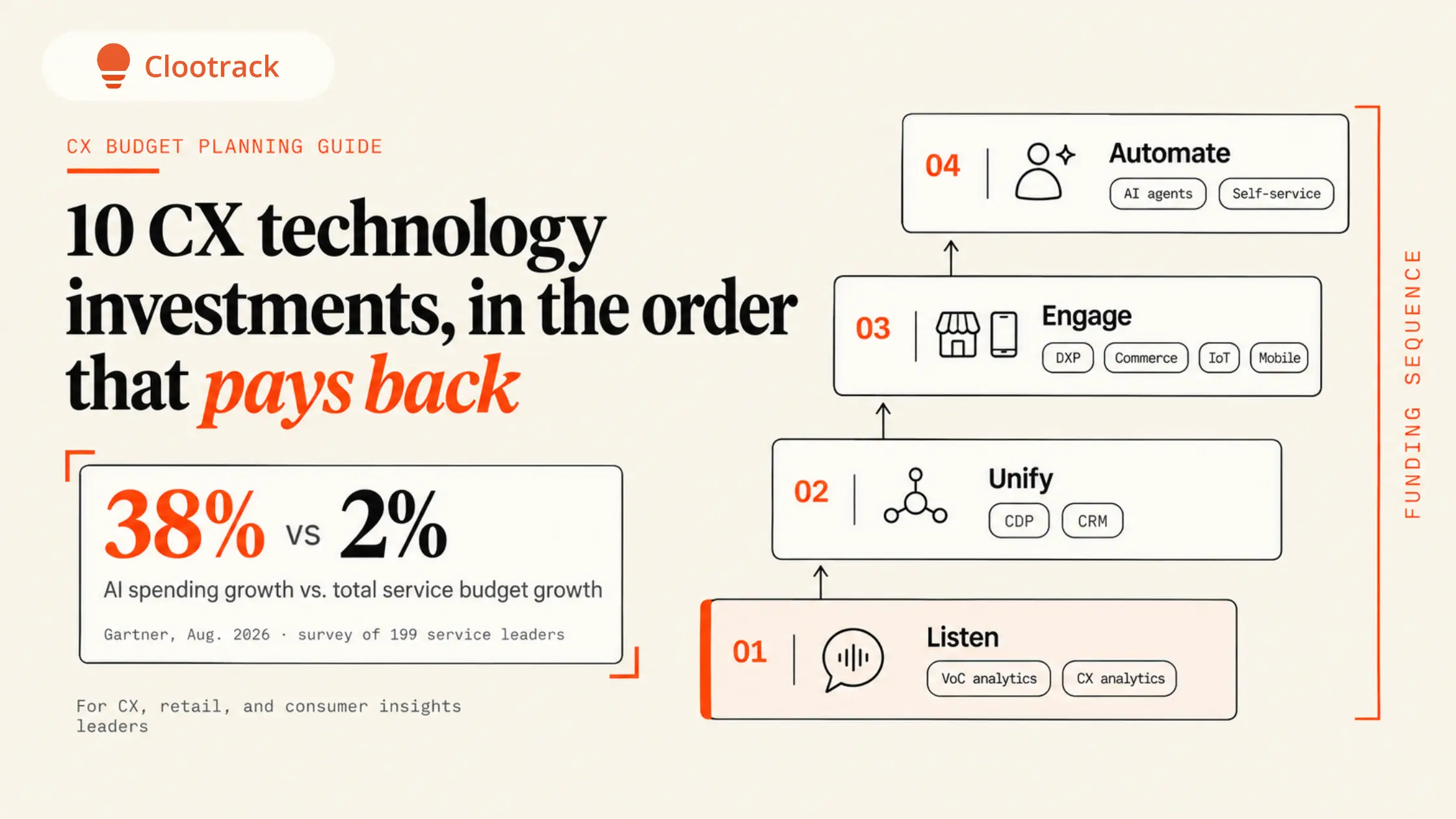
The 10 key customer experience technology investments are Voice of Customer analytics, CX analytics, customer data platforms, CRM, digital experience platforms, digital commerce, connected products, mobile experience, AI agents, and self-service. A practical funding sequence is to listen first, unify customer data, improve experiences across channels, and then automate. The logic is simple: understand which customer problems cost the most before investing in technology to fix them.
Customer experience technology is the set of software and data systems a company uses to understand, serve, and engage customers across customer touchpoints, from feedback analytics and customer data platforms to AI agents, commerce, and self-service.
This guide answers which customer experience technologies deserve budget in the 2027 planning cycle and in what order. It sets out a four-layer funding sequence backed by current analyst data, with next steps for the leaders who share responsibility for CX technology budgets.
The perspective comes from Clootrack's work with enterprise consumer brands. There, AI-powered Voice of Customer analytics turns reviews, surveys, tickets, and call transcripts into themes and drivers.
The 10 investments cover four jobs: hearing customers, knowing them, engaging them, and serving them at scale. Each row names the leader who usually owns the investment and the customer evidence that should exist before money moves.
The list runs in funding order, from listening at the top to automation at the bottom.That order matters more in 2027 budgets because AI is moving beyond chatbots that answer questions toward agents that can complete tasks, while knowledge content increasingly feeds AI systems as well as customers. When software acts on its own, acting on the wrong customer problem costs more, so evidence comes before tooling.
Spending is rising because executives see AI as the fastest lever on service cost and experience. Returns lag because few organizations have redesigned the work around it.
The money is not yet converting into enterprise value. McKinsey surveyed 1,719 respondents from May 4 to June 8, 2026, for its State of AI 2026 report. Only 37% attribute any EBIT impact to AI, essentially flat from the prior year. High performers behave differently: nearly three quarters fundamentally redesigned workflows because of AI, against one quarter of other respondents.
Budgets are loosening, which raises the stakes on choosing well. In Forrester's 2027 budget planning research, 55% of CX leaders expect spending growth of 5% or more, up from 39% a year earlier (Forrester, July 15, 2026; survey of more than 2,600 decision-makers).
The business implication is a tighter test for every line in the CX budget. With AI pulling ahead of every other line, a CDP upgrade or a mobile release must show which customer problem it removes and what that problem costs. The risk is funding by vendor momentum. The opportunity is real. Globally, among brands Forrester scored in both 2025 and 2026, 20% raised their CX Index scores and 8% declined (Forrester, June 9, 2026).
Fund the 10 investments in four layers: listen, unify, engage, then automate. Each layer supplies the evidence or data the next one needs to pay back.
Voice of Customer analytics and customer analytics come first because they show which problems matter, why they happen, and what they cost. That requires evidence across feedback sources, not just a survey sample: reviews, social posts, surveys, tickets, and contact center conversations.
The diagnosis gets sharper when unstructured feedback sits next to structured data such as returns, price, assortment, and sales. A rise in fit complaints means more when it lines up with higher returns on the same SKUs. The risk is buying analytics that report scores without causes. Next step: build one theme model across every feedback source, then rank themes by the cost they create.
A customer data platform and CRM show who customers are and what they did; Voice of Customer data explains why. Connect them so feedback themes, sentiment, and expressed purchase intent attach to profiles and accounts instead of living in a separate dashboard.
Data architecture matters here. McKinsey's 2026 survey counts a semantic layer or knowledge graph for company data among the practices AI high performers adopt more often than peers. The risk is a profile that is rich in clicks and empty of reasons. Next step: map each priority theme to the segments and accounts it affects, so outreach and service can respond to it.
Digital experience platforms, commerce, connected products, and mobile turn insight into experiences customers see. For retailers, the channel math sets the brief. U.S. e-commerce reached $340.2 billion in the second quarter of 2026, or 17.1% of total retail sales. That was up 12.2% year over year, against 6.7% for all retail (U.S. Census Bureau, Aug. 18, 2026).
Online grows nearly twice as fast, yet more than four in five retail dollars still move through other channels. Engagement investments must therefore connect store and digital journeys, from pickup to the post-purchase customer experience. The payoff is measurable: Forrester reports U.S. retailers with a strong total experience see a 3.8x revenue lift from retention and enrichment (June 9, 2026). For consumer brands, the next step is reading reviews by channel to see where online promises break in stores.
AI agents and self-service pay back last because they automate whatever the earlier layers reveal. Automating an unexamined process scales its failures. Content quality decides accuracy. Gartner surveyed 321 service and support leaders from September to October 2025. Of them, 58% aim to upskill agents into knowledge management specialists (Gartner, Feb. 18, 2026).
Automation is also reshaping roles rather than erasing them. In the same survey, 85% of leaders are adding new tasks and responsibilities to frontline agent roles (Gartner, April 28, 2026). The risk is a deflection rate that hides unresolved issues. Next step: automate intents that are high in volume and low in emotion and ambiguity, and keep people on complaints and advice.
Voice of Customer data shows, in customers' own words, where technology helps them and where it gets in the way. System metrics cannot show that on their own.
Customer behavior explains why this matters. Gartner surveyed 5,801 U.S. customers from January to February 2025. Of them, 54% trust human agents more than AI for product or service recommendations, and 32% trust AI more (Gartner, April 28, 2026). People want automation for speed and people for judgment.
Discovery is also fragmenting. In Gartner's August 2026 survey of 1,004 U.S. consumers, 34% were very or extremely willing to use GenAI tools for holiday gift recommendations. Shoppers who use AI for holiday inspiration consult 4.48 sources on average, versus 3.24 for those who don't (Gartner, Oct. 7, 2026). Feedback therefore lands in more places, so listening must span reviews, marketplaces, social, and service channels.
The same evidence works for strategy when you read competitors' customers too. CX competitive analysis with one theme model shows whether a weakness is yours or the whole category's. That answer decides whether to invest to catch up or invest to differentiate.
Each leader should act on the same customer evidence, but the action differs by role. The table applies three questions to every stakeholder: what is important, why it happened, and what to do next.
Each of these actions depends on combining sources. Reviews, surveys, tickets, calls, returns, price, assortment, and sales data each show part of a problem. Together they show its size and cause. Product teams, for example, get stronger roadmaps when product CX insights arrive with the return rates and SKUs attached.
Executive recommendation: Make a customer-evidence review a formal gate in the CX technology budget cycle. No investment advances without a named customer theme, its measured cost, and the metric it must move.
CX technology is moving from tools people operate to agents that act, and from dashboards people read to customer intelligence that AI assistants query directly.
Gartner predicts that by 2029, agentic AI will resolve 80% of common customer service issues without human intervention. It expects a 30% cut in operational costs as a result (Gartner, March 5, 2025). Service leaders expect GenAI chatbots to become their most valuable channel within two years, ahead of live chat and GenAI voicebots. They also expect no-code agent builders, communications platforms as a service, and customer identity and access management to deliver substantially more value (Gartner, Aug. 26, 2026).
Governance, identity, and data access are therefore becoming CX investments in their own right. Forrester's 2027 planning guidance points the same way: fund the data, context, and governance that AI agents need to act reliably, and cut AI pilots that lack governance (July 15, 2026). Customer intelligence will increasingly be consumed inside AI assistants rather than dashboards. Clootrack MCP, for example, gives assistants such as Claude, ChatGPT, and Copilot governed access to VoC, churn, loyalty, and sales data, alongside AI Decision Digests that summarize what changed. Brands that structure their customer evidence now will have agents that act on accurate signals later.
The best CX technology investment for 2027 is the one that removes a customer problem you can measure. AI, data platforms, and commerce tools all earn their place, but only after the listening layer shows where customers struggle and what that struggle costs. Brands that fund evidence first will spend less automating the wrong work and more on experiences customers notice.
Next step: See how customer evidence can sequence a CX roadmap with Clootrack Neo, the AI agent platform for Voice of the Customer.
Start from a quantified customer problem, not a feature list. Measure the theme's volume, trend, and affected segments in customer feedback, then attach its cost to serve, return, or churn exposure. Set a baseline before launch and define the outcome metric the investment must move within two or three quarters.
A customer data platform unifies identity, transaction, and behavioral data so teams know who customers are and what they did. Voice of Customer analytics interprets what customers say in reviews, surveys, tickets, and calls to explain why. Mature stacks connect both, attaching feedback themes and sentiment to customer profiles.
Business leaders should own the outcome, and IT should own architecture, security, and integration. Joint ownership prevents two failures: IT buying capable tools that solve no priority customer problem, and business teams buying point solutions that cannot share data. A shared roadmap reviewed against customer evidence keeps both accountable.
Use outside-in and inside-out metrics together. Outside-in metrics come from customers: complaint theme volume, sentiment, effort, and repeat contacts. Inside-out metrics come from the business: cost to serve, conversion, retention, and revenue per customer. An investment worked when both move in the expected direction for the problem it targeted.
Buy where the capability is a commodity and build where it encodes your differentiation. AI coding agents are moving that line. In McKinsey's 2026 survey, 32% of respondents said their organizations skipped buying software they could build in-house with AI coding tools. Customer data integration usually remains the deciding constraint.
Review it quarterly against current customer evidence and annually against strategy. Customer themes shift faster than budget cycles, especially after launches, price changes, or seasonal peaks. A quarterly check shows whether funded investments are shrinking their target themes and whether a new issue now outranks a planned project.
Share :


Analyze customer reviews and automate market research with the fastest AI-powered customer intelligence tool.