GLP-1 fitness and movement category demand: A retail planning guide

Last Updated:
May 15, 2026

Reading time:
Time
mins

GLP-1 fitness retail demand contains two structurally different signals inside the same category growth number. One is capability restoration. The other is preservation anxiety. They look identical in aggregate data. They require completely different commercial responses.
TL;DR
What are the two GLP-1 fitness demand signals? Capability restoration drives accessibility-framed movement behavior. Preservation anxiety drives maintenance-framed nutrition and tracking behavior. Neither responds to aspiration-framed merchandising.
What is the GLP-1 preservation economy? The cross-category demand cluster spanning protein foods, entry-level equipment, wearables as validation tools, and walking gear that forms around muscle loss anxiety during rapid weight reduction.
Why is standard fitness merchandising misaligned? Neither signal is about transformation or performance. One is about restored access. The other is about protecting what has been gained.
What recalibration is required? Reposition walking gear as capability restoration. Reposition protein, wearables, and strength tools as preservation maintenance. Remove aspiration framing from both.
What is GLP-1 fitness retail demand?
GLP-1 fitness retail demand is the structural shift in fitness and movement category purchasing behavior resulting from GLP-1 weight loss simultaneously unlocking physical capability and generating anxiety about muscle loss.
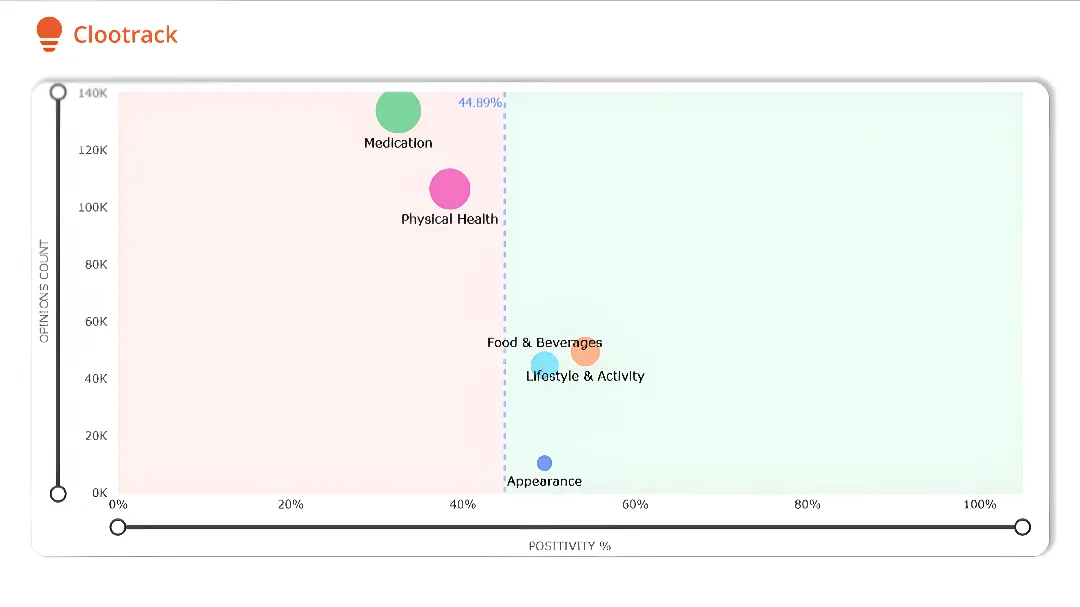
Across Clootrack's analysis of 95,854 GLP-1 consumer conversations collected between January 2022 and December 2025, Physical Activity appears in 15,112 mentions at 63.1% positive sentiment. The category looks broadly positive. Underneath it, two opposite motivations are driving demand in opposite directions.
Understanding what GLP-1 retail impact means for retail planning provides the broader context within which this fitness demand shift operates.
Signal 1: Capability restoration
Walking Routines leads at 78.4% positive because it requires no performance threshold, no recovery window, and no gym. Mobility Improvement at 95.7% positive and 120.4% MoM confirms restored physical access is the primary emotional driver.
Customer verbatim:
"I've only used walking outdoors and, eventually, jogging as workouts, along with weighted vests and hand weights. Lost 175 lbs so far. I hate the gym."
GLP-1 movement demand is accessibility-driven, not aspiration-driven. Retailers positioning walking gear and supportive footwear around transformation miss this consumer entirely.
Signal 2: Preservation anxiety
Muscle Mass Changes at 38.9% positive is the only major movement theme where sentiment skews below the dataset average despite high growth. The language is consistently defensive. Strength training is framed as protection. Wearables function as validation of maintenance, not motivation toward performance.
Customer verbatim:
"Yes. You have to keep muscle or you will get skinny fat. I've heard this over and over again. My dr even gets annoyed when patients come back and complain they have lost muscle."
The GLP-1 preservation economy in fitness retail
Preservation anxiety drives demand across traditionally separate categories simultaneously. Protein Foods at 2,866 mentions, 57.5% positive, 66.2% MoM growth is co-accelerating with Muscle Mass Changes at 50.9% MoM in the same consumer base. Activity Tracking at 73.1% positive confirms wearables function as proof of maintenance, not performance optimization.
Customer verbatim:
"I just try to close my Apple Watch rings every day. So far I've closed them for 10 straight weeks."
This preservation economy spans fitness equipment, protein foods, and tracking devices simultaneously and is invisible to siloed category analysis. For how the preservation economy fits within see the full GLP-1 household spend reallocation pattern.
Fitness category recalibration framework
- Capability restoration positioning: Walking-first merchandising. Supportive footwear for comfort and joint protection. Entry-level equipment emphasizing ease of use. Outdoor apparel for casual sustained activity.
- Preservation anxiety positioning: Strength training framed as muscle protection. Protein positioned for retention support. Wearables marketed as daily stability feedback tools. Body composition devices positioned as reassurance, not performance monitors.
FAQs
What is the GLP-1 preservation economy in fitness retail?
The cross-category demand cluster forming around muscle loss anxiety during GLP-1 weight loss, spanning protein foods, entry-level strength equipment, wearables as validation tools, and walking gear simultaneously. It is driven by protection motivation, not aspiration.
Why is GLP-1 fitness retail demand growing while some sentiment scores are low?
Two signals are operating simultaneously. Capability restoration carries high positive sentiment. Muscle Mass Changes carries below-average sentiment despite high growth because the motivation is anxiety, not inspiration. High growth at low sentiment is a mitigation demand signal, not a category health indicator.
Which fitness product clusters are growing in GLP-1 households?
Walking gear, accessible footwear, protein foods at 66.2% MoM, activity tracking at 41.2% MoM, and entry-level strength equipment. High-intensity performance equipment and transformation-framed products are not where GLP-1 fitness demand is consolidating.
How does GLP-1 affect fitness retail category margin?
Over-investment in high-intensity performance tiers while capability restoration and preservation economy clusters go underserved creates inventory misallocation and margin pressure. The growth clusters are at the accessible and maintenance end of the category, not the performance end.
How does GLP-1 change fitness retail merchandising strategy?
It requires separating capability restoration positioning from preservation anxiety positioning within the same category. Walking gear needs accessibility framing. Protein, wearables, and strength equipment need maintenance and protection framing. Aspiration framing serves neither consumer.
Is the GLP-1 fitness demand shift temporary or structural?
Structural. Capability restoration is a permanent behavioral change for consumers who have recovered mobility. Preservation anxiety will persist for the duration of active weight loss and may continue after stabilization. Both are driven by biological mechanisms, not promotional triggers.
Share :



Do you know what your customers really want?
Analyze customer reviews and automate market research with the fastest AI-powered customer intelligence tool.