



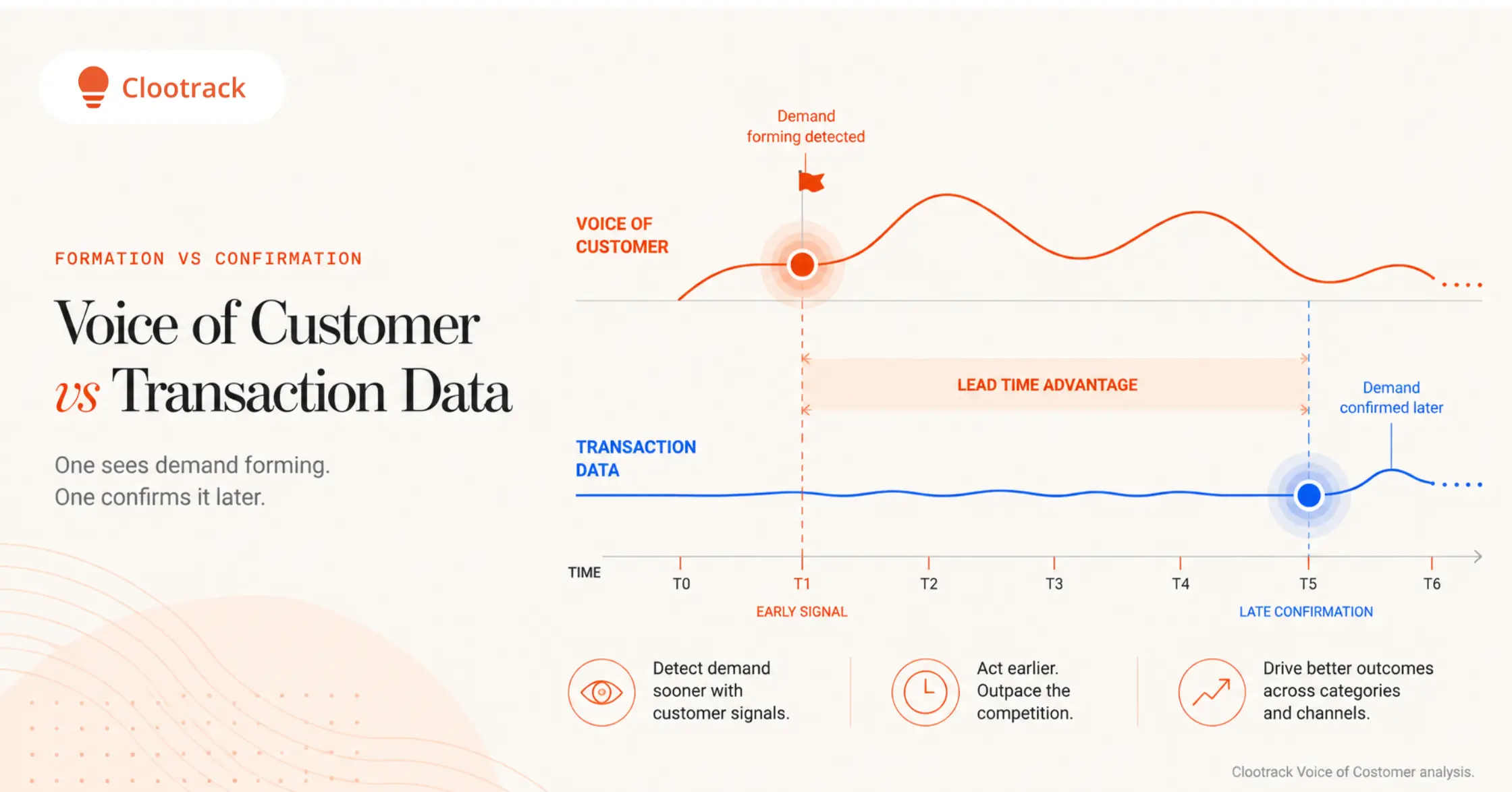
Transaction data measures what consumers bought after a purchase decision was made. Voice of Customer data measures why they are hesitating, what systems they are assembling, and how intent is reorganizing, before that intent settles into a purchase. One is a confirmation layer. The other is a formation layer.
In one line: Transaction data tells you what already happened. Voice of Customer data tells you what is about to.
Neither is wrong. They answer different questions. The error is using a confirmation layer to do a formation layer's job, then wondering why the signal arrived late.
Because transaction data sits at the end of a fixed sequence. Intent reorganizes first. Conversation reflects the reorganization. Purchasing follows. Revenue confirms it last. By the time a shift reaches a financial dashboard, the behavior has already hardened into habit, and the operational exposure is already embedded in inventory, promotional calendars, and working capital.
This is not a tooling flaw. Transaction systems are accurate records of stabilized behavior. The problem is timing. A category dip shows up only after consumers have already changed how they buy, which means the window to respond proactively has usually closed before the number moves. Reacting to a confirmed decline is competing for a position a faster mover has often already claimed.
See also: What Is GLP-1 Retail Impact? for how formation-layer detection works in practice.
Four signals form in consumer language well before they appear at the point of sale, and each maps to a specific commercial consequence.
Each of these is a leading indicator. None of them is in a transaction dashboard until after the fact.
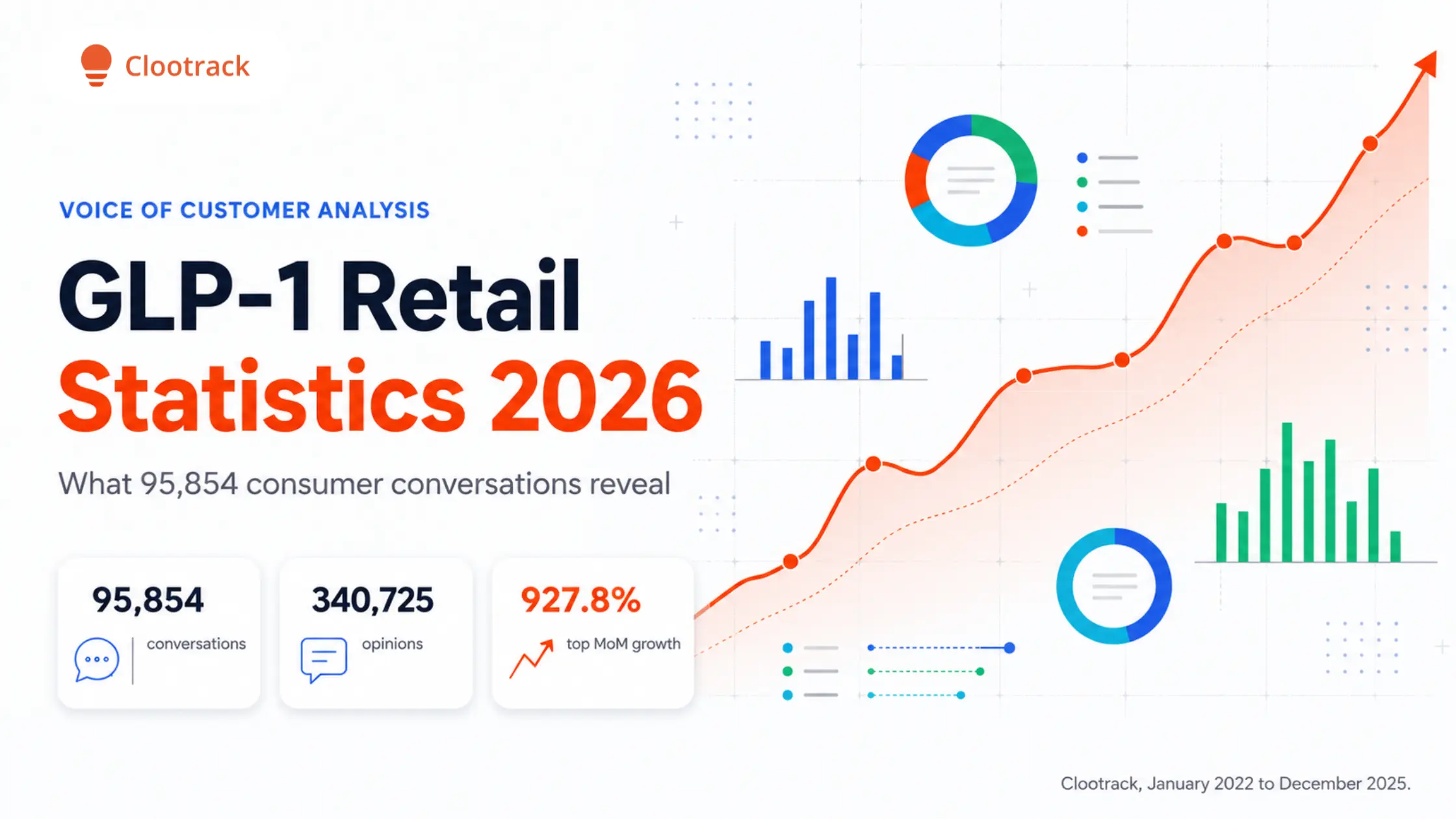
The GLP-1 effect on retail is the clearest current demonstration of the formation-versus-confirmation gap. Across 95,854 U.S. consumer conversations and 340,725 opinions (January 2022 to December 2025), four shifts were visible in language before they were measurable in sales.
The dose calendar, before intra-week sales volatility. Consumers described a weekly appetite rhythm tied to injection timing, captured across 12,725 dosage-pattern mentions, including carts that "look completely different depending on where I am in my week." That day-level volatility is averaged away in weekly and monthly sales totals.
See also: The GLP-1 dose calendar effect in grocery retail.
The GI stack, before basket analysis. Hydration practices (99.3% MoM growth) and side-effect management (43.4% MoM) appeared together in conversation as a coordinated routine, the co-mention clustering that signals system formation before it shows up as cross-aisle basket behavior.
See also: How GLP-1 side effects influence retail purchasing.
Apparel identity lag, before conversion decline. Body image conversations (6,464 mentions, just 48.5% positivity) carried explicit purchase paralysis, including "I went shopping three times last month and bought nothing." Traffic stayed healthy while conversion stalled, a gap a dashboard reads as healthy footfall right up until sales soften.
See also: How GLP-1 is stalling apparel conversion.
The beauty repair economy, before category mix shifted. Cosmetic interventions grew 927.8% month-over-month in conversation, driven by non-surgical repair-seeking and extensive wishlist and research behavior, well ahead of any reallocation visible in beauty category sales.
See also: The GLP-1 beauty repair economy.
In every case, the behavior was legible in language first. The sales number was the last to know.
Use both, in sequence. Voice of Customer data is the formation layer for early detection, and transaction data is the confirmation layer for validation and reporting. The advantage comes from reading the formation layer early enough to act, then using the confirmation layer to verify and scale the response.
In practice that means elevating behavioral signals to planning-grade inputs rather than treating them as contextual color. Sentiment asymmetry, co-mention clustering, and hesitation language should feed forecasting models and category reviews, not just insight presentations. The retailer who waits for transaction confirmation before acting is structurally late by design, because the confirmation layer cannot, by definition, report a shift before it has happened.
For the full picture of how this plays out across grocery, fitness, apparel, beauty, and household spending, see the pillar analysis: The GLP-1 effect on retail in 2026.
Transaction data records what consumers bought after a purchase decision was made. Voice of Customer data reveals intent, hesitation, and routine formation while demand is still forming, often weeks or months before it appears in sales. One confirms, the other forecasts.
No. They serve different functions. Transaction data is the system of record for revenue. Voice of Customer data is a leading indicator for early detection. The strongest planning combines both, using VoC to detect formation and transaction data to confirm and scale.
Because it sits at the end of a fixed sequence: intent reorganizes, conversation reflects it, purchasing follows, and revenue confirms it last. A sales figure cannot move until after behavior has already changed, so it reports shifts only once the window to act proactively has narrowed.
It surfaces leading indicators such as sentiment asymmetry, co-mention clustering, and hesitation language that precede transaction confirmation. Feeding these into forecasting models enables earlier detection of volatility, conversion friction, and cross-category system formation than transaction data alone allows.
Yes. In the GLP-1 dataset, the dose-driven weekly appetite cycle, the cross-aisle GI management stack, apparel identity lag, and the beauty repair economy were all visible in consumer conversation before they were measurable in transaction data.
Unsolicited consumer conversations from forums, social media, and review sites, where consumers describe real decisions in natural contexts rather than answering survey prompts. This captures active behavior and reconsideration as it forms, which is what makes it a formation-layer signal.
Share :



Analyze customer reviews and automate market research with the fastest AI-powered customer intelligence tool.
.webp)