


AI's impact on customer engagement is a shift in where engagement happens and who does the work. Shoppers now discover products and start service requests inside generative AI assistants, while brands answer with AI agents. Engagement improves when AI completes tasks with full customer context, and it erodes when AI stands between customers and the help they need.
AI-powered customer engagement is the use of machine learning, generative AI and AI agents to anticipate and act on customer needs. It spans discovery, purchase and service, guided by what customers say and do.
Customer engagement used to be measured inside channels a brand owned: its website, app, stores and contact center. Now, a growing share of it starts in assistants the brand does not control and ends with AI agents acting on a customer's behalf.
This guide explains where AI changes engagement, where it backfires and what CX, retail and product leaders should do next.
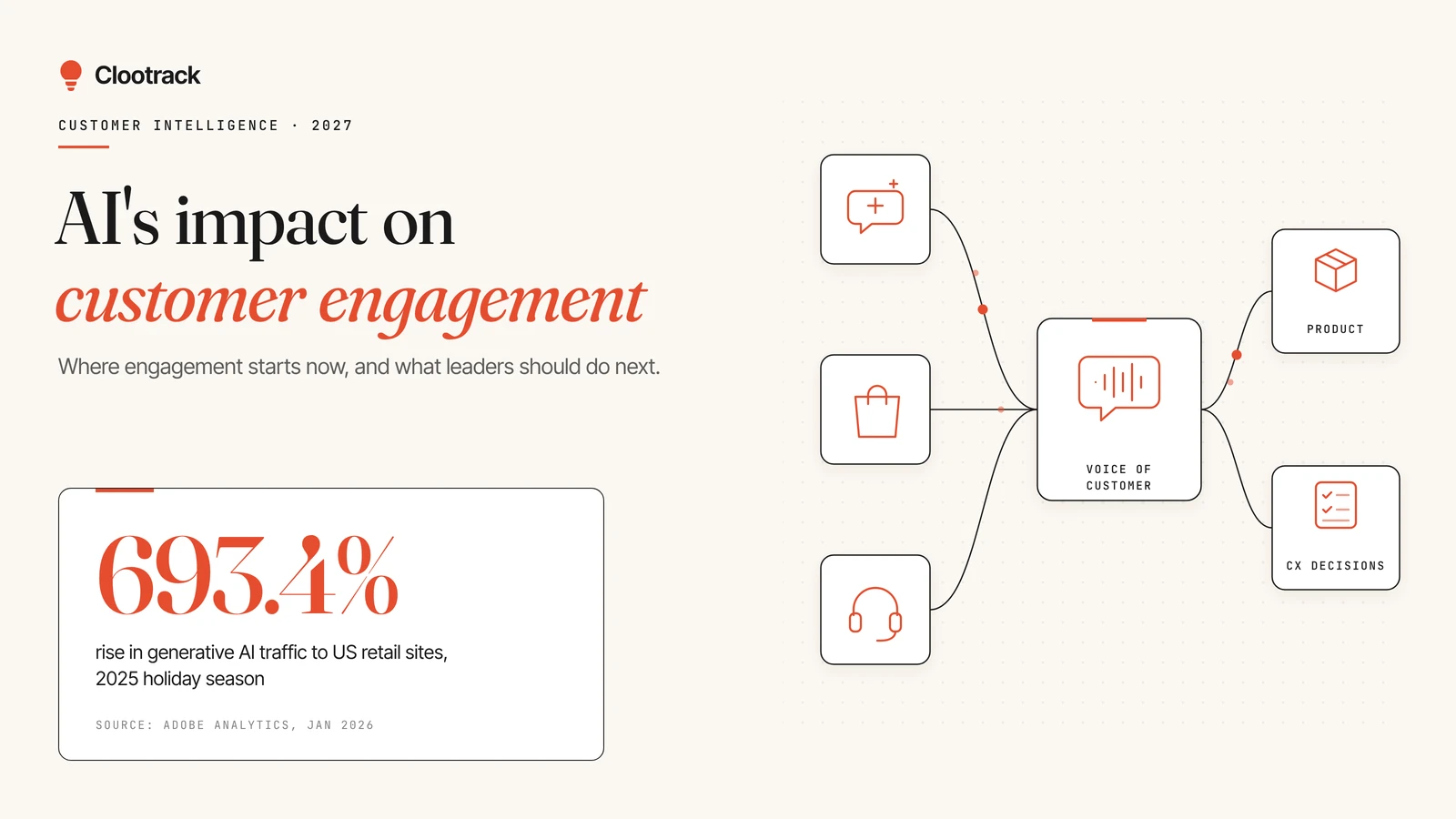
AI is moving the first moment of engagement out of brand-owned channels and into generative AI assistants. The shoppers who arrive from those assistants are also better qualified. AI referrals converted 31% more than other traffic sources in the November and December 2025 holiday season, according to Adobe Digital Insights' analysis of US retail site visits.
Service follows the same pattern. Gartner surveyed 3,566 B2B and B2C customers in February and March 2026. In their most recent service interaction, those customers were about three times more likely to use a third-party GenAI tool such as ChatGPT, Gemini or Copilot than a company chatbot.
The consumer behavior behind both findings is the same. Customers now research, compare and troubleshoot with an assistant first, then reach the brand later with more context and less patience. Two business implications follow:
AI creates the most value where it shortens the path from a customer signal to a decision. Five engagement layers account for most of the measurable impact.
The retail payoff in the Forrester finding above comes from consistency across these layers, not from any single AI feature. A recommendation engine that lifts conversion while service bots frustrate the same customers produces a net loss in loyalty.
Customer experience personalization is where most brands start, but the product and assortment layer is where retail intelligence compounds. When reviews expose a sizing or durability problem, fixing the product improves every downstream engagement metric at once. Product CX insights built on that feedback give merchandising and product teams one evidence base.
AI engagement disappoints when companies deploy it to deflect contacts instead of resolving them, and when the model acts on incomplete customer context. Customer sentiment is genuinely split: 50% of customers say service interactions are easier when companies use GenAI, according to the same Gartner 2026 customer survey.
Trust in AI judgment also lags. Gartner surveyed 5,801 US customers in January and February 2025. Of those, 54% trust human agents more than AI for product or service recommendations, while 32% trust AI more. Budgets are moving faster than trust: a Gartner survey of 199 service leaders in April and May 2026 found AI spending up 38% while overall service budgets grew 2%. Spending is outpacing proof of value.
The business risk is asymmetric. Automation savings appear in the next quarter's budget, while lost loyalty arrives later and is harder to attribute. Contact center analytics that review AI and human conversations on one scorecard make that cost visible.
Voice of customer analytics is the feedback loop that shows whether AI engagement is working. Customers describe friction in their own words long before it appears in churn or revenue.
AI agents also create a new class of unstructured data: bot transcripts, escalation notes and reviews that mention the assistant. Fixed coding frames miss these failure modes because they did not exist when the taxonomy was built. Unsupervised theme discovery and aspect-level sentiment analysis surface them as they emerge.
Feedback alone rarely explains the whole story. The stronger signal comes from analyzing reviews, surveys and service transcripts together with returns, price, assortment and sales data. This multi-source approach underpins Clootrack Neo's AI Decision Digests, which rank what matters, why it is happening and what to do next.
Leaders should treat AI engagement as an operating decision owned by each function and grounded in shared customer evidence, not as a single technology rollout. The same finding means something different to each stakeholder.
The highest-return first step is narrow. Pick one journey where AI and human service overlap, such as returns. Run it on shared evidence for a quarter before scaling automation. Pairing predictive and prescriptive CX analytics in that pilot turns early churn and complaint signals into assigned actions with owners.
The next phase is agentic: AI that completes tasks for customers and employees, which shifts competition toward whoever holds the most reliable customer context. Gartner predicted in March 2025 that agentic AI will autonomously resolve 80% of common customer service issues by 2029. It expects a 30% cut in operational costs as a result.
Customers are already moving there. In Gartner's 2026 customer survey, 58% of GenAI users had used it to complete a task on their behalf, rising to 74% in B2B. Brands will increasingly serve AI agents acting for shoppers, which raises the value of clean product data and consistent policies.
Inside the enterprise, the same shift is underway. Teams now ask AI work fronts such as Claude, ChatGPT and Copilot customer questions directly. Governed access through the Model Context Protocol lets those tools query VoC, churn, loyalty and sales data under role-based permissions. That is the approach behind Clootrack MCP. For CX and insights leaders, that makes data governance an engagement capability, not only an IT control.
AI's impact on customer engagement will be decided by customer context, not model choice. Assistants and agents are becoming interchangeable, but the evidence a company feeds them is not. Brands that connect what customers say with what they buy, return and complain about will engage better at every layer. Brands that automate on partial context will simply scale their blind spots.
Explore how Clootrack Neo turns reviews, surveys, service conversations and operational data into prioritized decisions for CX, product and retail teams.
Industries with high interaction volume and frequent comparison shopping feel it most: retail and ecommerce, consumer brands, banking, telecom and travel. Adobe's 2025 holiday data showed retail with the strongest growth in AI-referred traffic of any industry it tracks. Shoppers use assistants to compare products, prices and reviews.
A traditional chatbot retrieves information and answers predefined questions. An AI agent understands intent, reasons across data and takes action, such as processing a return, rebooking an order or escalating with full context. Agents raise the ceiling on resolution, but they also raise the cost of errors, so governance matters more.
Pair operational metrics for AI-handled contacts with what customers say about them. Tag every review, survey comment and transcript that mentions the assistant, then compare sentiment and recurring themes for that segment against human-handled contacts over time. Aggregate scores often hide a specific failure, such as a broken handoff on one journey.
AI absorbs routine contacts, so human agents handle more complex, emotional and high-value conversations. A Gartner survey of 321 service leaders, conducted in September and October 2025, found 85% are expanding human agent responsibilities as AI reduces contact volume. Agents increasingly work alongside AI assistants that summarize history and suggest next steps.
Behavioral data shows what customers did, while voice of customer data explains why. Feeding stated preferences and complaints into personalization models helps them avoid disliked offers. It also lets them recommend products that solve the problem a customer described, not just the last item viewed.
Assistants compress research into one conversation and return a short list instead of a page of links. Products with clear, accurate attributes and consistent review sentiment are easier for an assistant to recommend with confidence. That turns product content quality and review analysis into discovery levers, not only conversion levers.
Agents need permissioned access to product data, policies, prior contacts and the customer's own feedback. Without prior contacts and feedback, an agent cannot tell a frustrated repeat customer from a first-time question. Role-based controls and anonymization of personal data keep that context useful without exposing sensitive information.
Share :


Analyze customer reviews and automate market research with the fastest AI-powered customer intelligence tool.