
🎉 Clootrack launches Brand Experience OS with Interbrand, the world’s first brand consultancy and creator of Best Global Brands →
Read the story
%201%20(1).svg)



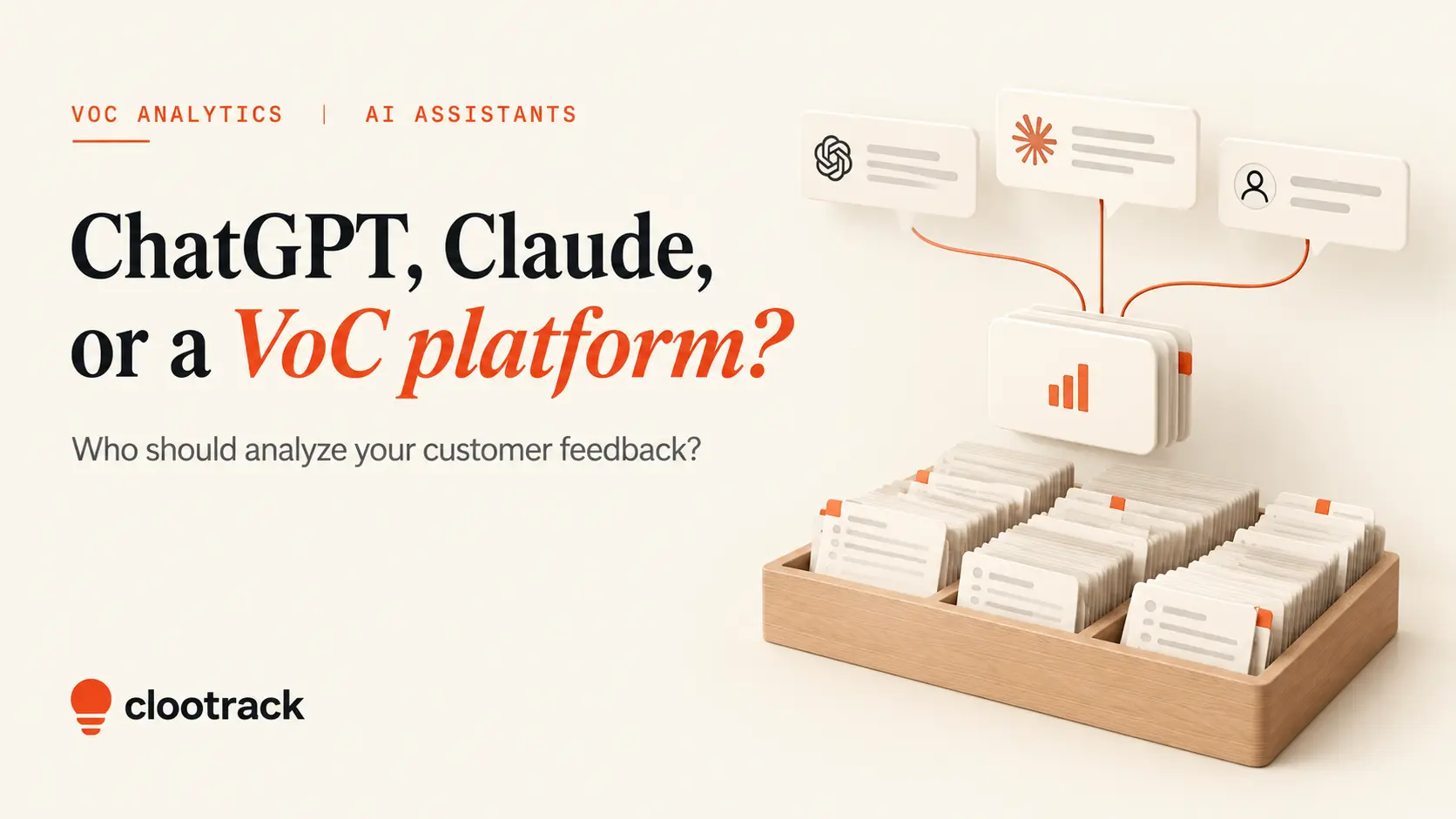
ChatGPT, Claude, Copilot, and Gemini can summarize a bounded set of customer feedback well. They are not built to collect feedback from dozens of sources, process every opinion consistently, or apply one governed method for every user. A VoC analytics platform does that work and can feed the results into the assistant your team already uses.
What is a VoC analytics platform? A Voice of Customer (VoC) analytics platform is software that collects customer feedback from internal and external sources. It structures every opinion into themes and sentiment and delivers consistent, traceable insight to the teams that act on it.
Most insights, CX, and data leaders now have an AI assistant on their desk. So when they evaluate Voice of Customer analytics, one question comes first: why not just use Copilot, Gemini, Claude, or ChatGPT? It is the question Clootrack hears most often from teams comparing options.
This article answers it directly: what assistants do well, where they break at enterprise scale, and how the two fit together. It draws on Clootrack analysis data and current research on large language model reliability.
Yes, for a bounded set, such as a few hundred survey comments or one product's reviews. Reliability becomes harder to guarantee when the task means combining evidence across large volumes. Pasting feedback into a chat works because the model reads everything at once. That same design becomes the limit when feedback runs into thousands of records across sources.
A March 2026 study accepted at the MathAI 2026 conference tested two OpenAI models on 200 questions per benchmark. It held the answer constant while adding irrelevant text around it. On questions that combine several pieces of evidence, GPT-4.1's accuracy fell from 57.5% to 30.5%. The input had grown only from 256 to 2,048 tokens, roughly 1,500 words. The study tested question answering, not customer feedback, and single-fact lookups held up far better. The implication for VoC analysis is that synthesizing what customers say across many reviews is also a multi-evidence task.
Volume is only half the issue. A single review often mixes praise and complaint, and a summary of whole reviews blends the two into one verdict. Accurate analysis splits each review into distinct opinions, then assigns each one a theme and sentiment through unsupervised thematic analysis.
A review-level summary would count each of those reviews once, flattening mixed feedback into a single verdict and hiding which aspect actually drove the rating.
Because a general assistant rebuilds its method on every prompt, two people asking the same question can get different counts, definitions, and conclusions. Wording changes the result. So does which files each person uploaded, and whether the model reads "adoption" as product usage or as purchase.
The way a question is framed also sways the answer. Stanford's 2026 AI Index reports that across 24 leading models, accuracy fell when a false statement was presented as the user's own belief. Newer reasoning models scored 62.6% on those first-person false beliefs. The implication for customer analysis: asking why shoppers dislike the new packaging may produce an answer to a premise the data never supported.
Those errors travel. Workiva's May 2026 survey polled 2,272 finance, risk, sustainability, and legal professionals. Among its executives, 26% said internal audits had caught AI errors that reached external audiences or the board.
A VoC platform can standardize the method once. The unit of analysis, time window, and definitions are set in the workflow, so every user starts from one governed dataset. Answers from Clootrack's Genie reasoning agent are grounded in that structured dataset and cite the underlying verbatims with source and date. Business context, such as what each product line or metric means, is configured once rather than retyped in every prompt.
The practical difference shows up in review meetings. When a finding is challenged, the team can open the exact opinions behind it instead of rerunning a prompt and hoping for the same answer.
The assistant can only analyze what someone has already collected. The feedback that drives decisions is usually spread across sources no one has pulled together. Surveys sit in one system and contact center transcripts in another. Ratings and reviews are scattered across dozens of retailer sites, forums, and app stores.
Collecting that data is its own discipline. It means crawling only what is publicly and legally accessible and removing duplicates and spam. It also means matching the same product across retailers that list it under different names. Unified VoC data from internal and online sources is the precondition for every insight that follows.
Data foundations are also associated with stronger AI outcomes. Gartner reported in April 2026 that organizations with successful AI initiatives invest up to four times more in foundations such as data quality and governance. That comparison is measured as a share of revenue. The finding draws on a survey of 353 data, analytics, and AI leaders fielded in November and December 2025.
Competitive questions make the gap obvious. In Clootrack's men's denim analysis, published March 2026, nearly half of all outbound brand switching traced to consistency gaps rather than competitor appeal. That comparison was possible because reviews across the category were collected and analyzed with the same methodology. An export from one brand's own channels would not have contained it.
They solve different halves of the problem: the assistant is where people ask questions, and the platform is what makes the answers reliable.
The right-hand column is the target state. People keep the tool they already use, and the numbers behind it hold up when someone asks where they came from.
It sits underneath: the platform prepares and governs the customer data, and the assistant your team already uses queries it. Model Context Protocol (MCP) is the open standard that connects the two. Clootrack's guide to what MCP means for customer intelligence teams covers the protocol itself.
Clootrack Neo and Clootrack MCP make one governed layer of customer intelligence, covering Voice of Customer, churn, loyalty, and sales data. That layer is available to Claude, ChatGPT, Copilot, and other MCP-compatible assistants. Context and semantic layers carry business definitions, product catalogs, and metric logic, so the assistant answers from the data rather than from its general training. Gartner predicted in March 2026 that by 2030, universal semantic layers will be treated as critical infrastructure alongside data platforms and cybersecurity. Its analysts tie the semantic layer directly to AI accuracy and to stopping costly inconsistencies before they spread.
The work interface is also shifting. As more teams start their day in an AI assistant instead of in separate applications, insight will increasingly need to arrive where they already work. That favors pushed, role-specific output such as AI Decision Digests, which tell each stakeholder what is important, why it happened, and what to do next.
For IT and security teams, this setup means one governed connection to review. The alternative is a steady stream of feedback files uploaded into chats by individual users.
When the question is one-off, the data is small and already in hand, and a directional answer is acceptable. Summarizing a round of interview notes, drafting a survey, or taking a quick read of a few hundred open-ended comments are good fits.
It stops being enough in four situations: recurring analysis, competitor comparisons, multi-source questions, and any output that will shape budget, product, or merchandising decisions. In each case the method has to stay fixed and the data has to be complete, which a chat session cannot promise.
A useful test is whether the answer will be cited again. If a finding will appear in a quarterly review, a supplier conversation, or a product roadmap, the analysis belongs in a platform. The assistant then becomes the way people ask about it.
Being honest about this boundary matters in both directions. Forcing a platform onto every quick question slows teams down. A one-off pulse check rarely needs more than a capable assistant and a clear prompt.
Start with the decision the analysis must support, then give each stakeholder the part of the setup they own. The strongest conclusions come from reading feedback alongside sales, returns, price, and assortment data rather than any single stream.
The business risk is not the software bill. It is a merchandising, product, or service decision made on a number no one can reproduce.
General AI assistants are now the front door to how teams work, and that is good news for Voice of Customer programs. They are not the foundation. Decision-grade customer insight needs complete collection, opinion-level analysis, fixed definitions, and traceable evidence, delivered into the tools people already use. Treat the assistant as the interface and the VoC platform as the data layer beneath it, and both earn their place.
See your customer data answer back. Clootrack MCP connects governed Voice of Customer data to the AI assistant your team already uses. Book a Clootrack MCP walkthrough.
Yes. ChatGPT can label sentiment on reviews you paste in, and it handles short, plain statements reasonably well. It is less dependable on sarcasm, mixed reviews, and category language where polarity flips, such as a utility customer praising low usage. Anchoring analysis to the product category and validating against a labeled sample improves accuracy at scale.
It depends on the plan your team uses and your company's AI policy, since consumer and enterprise versions carry different data terms. Remove personal information before uploading anything. When evaluating a VoC platform, ask whether each customer has an isolated tenant and whether customer data is ever used to train models.
Yes, for a single survey wave. Comparing waves is harder, because the themes an assistant finds can shift each time you prompt it, which makes trend lines unreliable. Tracking programs need themes that stay stable across waves yet still surface new topics as they emerge. Unsupervised theme detection in a VoC platform is designed to provide both.
It can summarize individual calls well. Program-level analysis needs more. It means separating customer speech from agent speech, joining calls that pass from a voice bot to a live agent, and counting contact reasons consistently. Across thousands of long transcripts, those steps happen in a processing pipeline before any assistant can reliably explain why customers call.
You can, and teams with strong data science groups sometimes do. The ongoing cost is the hard part: collection pipelines break, customer language and product lines change, and themes need revalidation whenever models update. Weigh whether that upkeep differentiates your business or whether a maintained platform frees your team for work that does.
Only within the snapshot you give it. Spotting an emerging issue means comparing current feedback against a baseline and noticing a small theme growing before it becomes a large one. That requires continuous collection and consistent theme definitions over time, so alerts reflect real change in customer experience rather than a differently worded prompt.
Share :



Analyze customer reviews and automate market research with the fastest AI-powered customer intelligence tool.
.webp)