

Clootrack is now officially available as a ChatGPT Plugin
Install now




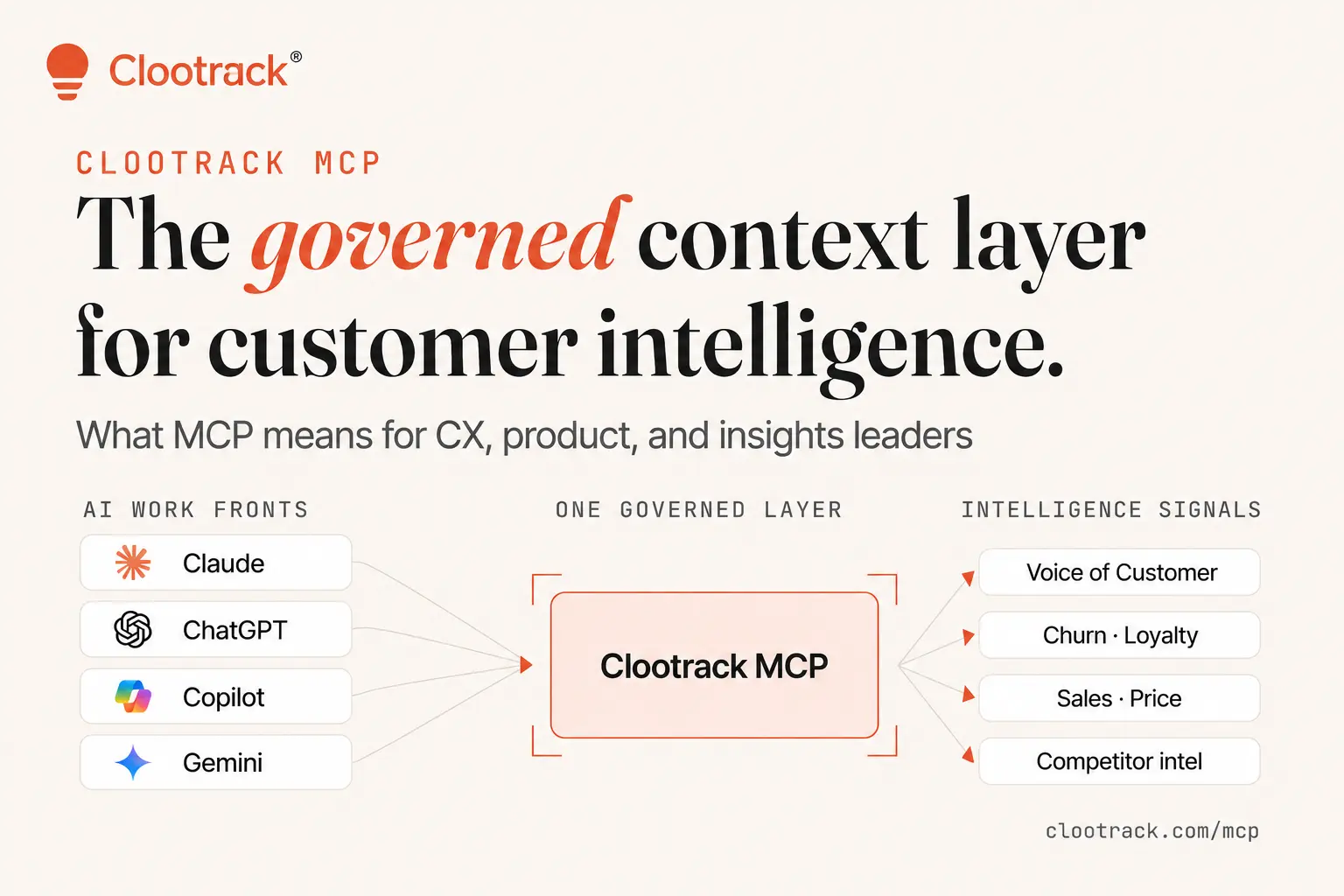
The Model Context Protocol (MCP) is an open standard that lets AI tools such as Claude, ChatGPT, Copilot, and Gemini securely access external data and take action. For customer experience and insights teams, MCP turns a customer intelligence platform into live, governed context that AI agents can query, report from, and act on.
The value is not simply giving AI access to customer data. It is helping customer intelligence teams move from questions to decisions and from decisions to action, without leaving the AI tools where work already happens.
Definition: The Model Context Protocol (MCP) is an open source standard, introduced by Anthropic in November 2024, that defines how AI applications connect to external data sources, tools, and workflows through a common client and server architecture.
Nearly every enterprise software pitch now ends with "we support MCP," but most explanations of the protocol are written for developers. This guide is written for customer intelligence, CX, product, and insights leaders. It explains what MCP is in plain terms, why AI agents stall without governed customer context, what changes when agents can reach Voice of Customer and revenue data directly, and how to roll out MCP without creating a new governance problem.
MCP works through three components: a host, a client, and a server. The host is the AI application a person talks to, such as Claude or ChatGPT. The client translates the AI's request into the protocol's standard format. The server sits in front of a data source or tool and exposes what the AI is allowed to see and do.
The useful analogy is a universal port. Before MCP, connecting AI applications to business systems meant building a custom integration for every pairing of AI tool and data source, a burden engineers call the N by M integration problem. MCP collapses that into one standard: a system exposes one MCP server, and any compatible AI application can discover and use it.
The standard has moved fast from a vendor project to shared infrastructure. Governance transferred to the Agentic AI Foundation under the Linux Foundation in December 2025, and the protocol's official SDKs were seeing close to half a billion downloads a month by July 2026, per the MCP maintainers. For buyers, that trajectory matters: an MCP investment is not a bet on one AI vendor.
MCP matters because it removes the biggest blocker between AI agents and reliable customer decisions: access to governed, current customer context. McKinsey's global State of AI survey, published in November 2025, found that 88% of organizations use AI in at least one business function, and 62% are at least experimenting with AI agents, yet only 23% are scaling an agentic system anywhere in the enterprise, usually in just one or two functions.
The challenge is increasingly less about whether models can reason and more about whether they can reach the right, governed context. An agent asked "why did detractor volume spike in the Northeast last month" has no way to answer from training data. The evidence lives in unstructured customer signals, including reviews, survey verbatims, support conversations, and social posts, alongside structured churn, sales, and loyalty records. Without a live connection, the agent either declines or, worse, answers confidently from stale general knowledge.
That is a consumer behavior problem as much as a technical one. Customers describe their experience in their own words across dozens of channels, and Voice of Customer analytics exists precisely because that language does not arrive pre-structured. MCP is the bridge that lets an AI work front reach that analyzed signal, the same depth of signal reflected in Clootrack's 100 billion token milestone, instead of guessing.
Teams can generate reports, create tickets, trigger alerts, and automate workflows directly from customer intelligence without leaving the AI tool they already work in. Through Clootrack MCP, an AI work front can query Voice of Customer themes alongside churn, sales, transaction, loyalty, price elasticity, campaign effectiveness, and demand forecasting data from a single interface, then act on what it finds.
The same finding also lands differently for each stakeholder, which is where an agent connected to multi-source evidence earns its keep. Take a churn spike traced to a delivery experience theme:
One governed MCP connection answers all four from the same evidence base, in each leader's own AI work front, rather than forcing a single generic recommendation. Teams already using conversational analysis through Genie will recognize the pattern: the question stays in natural language, and the answer stays grounded in analyzed customer data.
AI-ready customer data is data an AI application can understand, reason over, and use reliably, which requires context, semantic structure, and purpose-built tools rather than raw table access. Pointing an agent at bare schemas and raw verbatims produces confident but inconsistent answers, because the model has to guess what counts as churn, how sentiment is scored, or which of three revenue fields is canonical.
A semantic layer resolves that guesswork by encoding business meaning: metric definitions, entity relationships, and the taxonomy that organizes unstructured feedback into stable, comparable themes. Depth matters here. A taxonomy built from analyzing more than 100 billion tokens of Voice of Customer text behaves very differently from one improvised per query, because themes stay consistent across time, categories, and channels.
Breadth matters equally. Customer truth is holistic: unified VoC data sources combined with structured sales, returns, and price and assortment intelligence give an agent the retail intelligence context to connect what customers say with what they do. An MCP layer that spans structured and unstructured data together is what turns an AI answer into a decision-grade answer.
The main risks are MCP sprawl, ungoverned access, PII exposure, and unverifiable answers. Each is a governance problem that determines whether agent output can be trusted for decisions.
MCP sprawl happens when every tool and table exposes its own server, leaving security teams to validate dozens of fragmented interfaces and leaving agents to reconcile conflicting numbers across them. Consolidating customer intelligence behind a single governed MCP layer means teams validate and approve one interface, and every AI work front reads from the same source of truth.
Access control should follow the platform, not the protocol. Clootrack MCP enforces the role-based permissions already configured in the platform, so an agent acting for a user can only reach data that user is authorized to view. PII belongs even further upstream: sensitive information is anonymized at the data ingestion and analysis layers, so the MCP interface exposes only final, AI-ready data to authorized users.
The business implication is direct. Governance is not overhead on agentic AI; it is the difference between an AI answer an executive can act on and one that has to be re-verified by an analyst, which erases the speed the agent was meant to deliver.
MCP standardizes both data access and actions across every compatible AI application, while APIs, retrieval-augmented generation, and function calling each solve a narrower slice of the problem.
The approaches also combine: an MCP server often wraps existing APIs, and retrieval can operate behind an MCP tool. The strategic difference is that MCP provides a shared standard for AI work fronts to discover and use data and tools without requiring a bespoke integration for every connection.
Executives should start narrow, govern first, and expand on evidence. A workable sequence:
The recommendation for leadership: treat MCP readiness as a data strategy decision, not an IT integration ticket. The teams that compress a two-week insight-to-action cycle into a same-day loop will set the operating tempo their competitors are measured against.
The protocol's July 2026 specification moved MCP to a stateless core that scales on ordinary web infrastructure, with enterprise-managed authorization maturing alongside it, which clears the two practical objections large organizations raised most: scalability and login sprawl. The direction of travel is agents that act without being prompted, monitoring customer themes continuously and opening the ticket before a human asks.
The strategic outlook follows from that. As AI work fronts become the front door to enterprise decisions, the customer intelligence that is MCP-reachable becomes the context those decisions are made on, and intelligence that is not reachable is simply absent from the workflow. The evaluation criteria for the whole category are shifting the same way, as our review of AI tools for market research found: connectivity to the tools where work happens is now table stakes.
MCP is now the connective standard between AI agents and enterprise data, and for customer-facing decisions the deciding factor is not protocol support, which is quickly becoming universal, but the quality of the context beneath it. Governed, semantically structured, multi-source customer intelligence turns an AI answer into a decision. Teams that connect that intelligence to their AI work front now will operate at a tempo the rest of their market has to answer to.
Ready to put customer intelligence on your AI work front? Configure Clootrack MCP and give Claude, ChatGPT, Copilot, and Gemini governed access to your customer data.
Anthropic introduced MCP in November 2024 as an open source standard. Governance moved to the Agentic AI Foundation, hosted by the Linux Foundation, in December 2025, with maintainers releasing regular specification updates, most recently in July 2026. The protocol is not controlled by any single AI vendor.
No. Configuring an MCP connection is a one-time administrative step. After that, business users simply ask questions in plain language inside the AI tool they already use, and the agent handles discovery, querying, and formatting behind the scenes. No platform training or query language is required.
Claude, ChatGPT, Microsoft Copilot, and Google Gemini all support MCP, along with enterprise assistants such as Glean and developer tools such as Cursor and VS Code. Because MCP is an open standard, a single governed server works across all of them without separate integrations.
MCP sprawl is the proliferation of fragmented MCP servers, one per tool or dataset, each requiring separate security validation and each capable of returning slightly different numbers. It matters because sprawl multiplies governance workload and undermines trust in agent answers. A single consolidated MCP layer avoids both problems.
In a well-designed architecture, PII is handled before the protocol layer. Clootrack anonymizes sensitive information at the data ingestion and analysis layers, so the MCP interface exposes only final, AI-ready data. Access then follows role-based permissions, meaning agents can only retrieve data their user is authorized to view.
Clootrack MCP exposes structured and unstructured customer intelligence from one interface: Voice of Customer themes and sentiment, churn, sales effectiveness, transactions, loyalty, price elasticity, competitor intelligence, campaign effectiveness, and demand forecasting. Agents can generate reports, trigger alerts, create tickets, and automate workflows from that data.
No. An API is one system's specific interface, and every AI tool needs custom code to use it. An MCP server is a standardized layer, often built on top of existing APIs, that any MCP-compatible AI application can discover and use without bespoke integration work.
Share :



Analyze customer reviews and automate market research with the fastest AI-powered customer intelligence tool.
.webp)