
What is digital transformation? Definition, types, examples

Last Updated:
September 3, 2026

Reading time:
Time
mins
Digital transformation is the adoption of digital technology to fundamentally change how a business operates, serves customers, and creates value. It goes beyond moving processes online: it changes what an organization can sense, decide, and do, with analytics acting as the layer that turns the resulting data into decisions.
Key takeaways
- Digital transformation succeeds or fails on analytics: technology generates data, but only analysis converts it into decisions that change outcomes.
- A Clootrack study of 84,497 customer conversations comparing traditional banks and neobanks found digitally enabled features, led by app performance and mobile banking, among the decisive customer experience drivers.
- The next phase is agentic, with AI systems that answer business questions directly rather than producing reports for humans to interpret.
Digital transformation is the redesign of a business around digital technology and data, changing how it connects with customers, runs operations, and structures itself, so it can sense change and act on it faster.
What is digital transformation?
Digital transformation is a change in how an organization works, not just in the tools it uses. Digitization converts an existing process to a digital channel, such as an online form replacing a paper one. Digitalization uses digital tools to improve how a process runs. Transformation is broader: it redesigns products, operations, and often the business model itself around what digital technology and data make possible.
Banking shows the full arc. Depositing a check once required a branch visit and a queue; today customers transfer money, open accounts, and apply for loans from a phone. The banks that transformed did more than digitize the old branch process: they rebuilt their operating model around digital channels, which improved customer experience, cut operating cost, and created new revenue streams.
What are the main types of digital transformation?
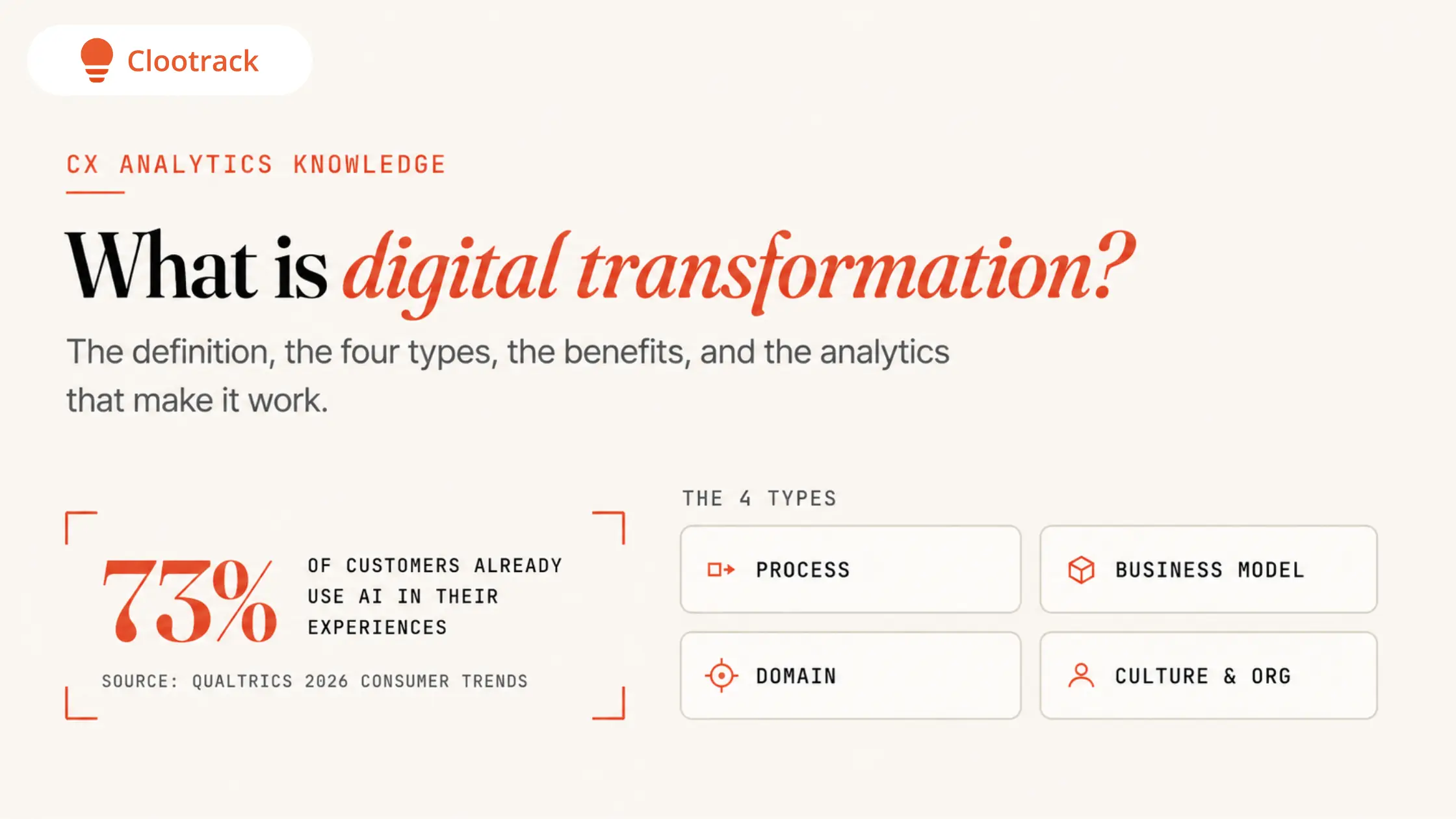
There are four widely recognized types of digital transformation, and mature programs usually run several at once.
- Business process transformation: redesigning workflows with data, analytics, and automation, such as replacing manual reporting with continuous dashboards.
- Business model transformation: changing how value is delivered and monetized, the way streaming replaced physical media and ride-hailing replaced dispatch.
- Domain transformation: using digital capability to enter an adjacent market, as cloud providers grew out of retail and software companies.
- Cultural and organizational transformation: shifting mindsets, skills, and ways of working so the other three types stick.
The fourth type is the most commonly neglected and the most decisive, since process and model changes fail when the organization operating them does not change with them.
What are the benefits of digital transformation?
The benefits of digital transformation are faster decisions, better customer experience, lower operating cost, new revenue streams, and greater resilience to market change. Decision speed improves because data reaches decision-makers continuously instead of through periodic reports. Customer experience improves because digital channels remove effort and personalize interactions. Cost falls as automation absorbs repetitive work, while digital products and channels open revenue that physical operations could not reach.
The benefits compound only when analytics is in place to measure them; without a baseline and continuous measurement, a transformation program cannot demonstrate which of these gains it actually produced.
Why is analytics central to digital transformation?
Analytics is central because transformation multiplies the data a business generates, and data without analysis changes nothing. Every digital channel, product, and interaction produces signals, and analytics is what converts them into an understanding of customer behavior, operational performance, and market movement.
The contribution runs at three levels. Descriptive analysis shows what is happening across the transformed business. Diagnostic analysis, including smarter data visualization for customer experience decisions, explains why. Predictive analysis anticipates demand, risk, and changing customer needs so plans are made ahead of events rather than after them. AI-powered Voice of Customer analytics applies all three levels to customer language specifically, across reviews, calls, chats, and surveys.
What are the key components of analytics in digital transformation?
Three components turn raw data into transformation decisions: data collection and governance, analysis and insight generation, and decision-making based on those insights.
Collection and governance come first because insight quality is capped by data quality. That means drawing on internal sources such as CRM, transaction, and service data alongside external sources such as reviews and social conversations, with governance processes that keep the data accurate, deduplicated, and secure.
Analysis converts that foundation into meaning through statistical techniques, machine learning, and thematic analysis of unstructured feedback. The final component is the one most programs underinvest in: routing insights to decision-makers so they change pricing, product, marketing, and operations choices. Actionable consumer insights exist precisely to close that last gap between analysis and action.
What does digital transformation look like in practice?
Banking offers a measured example. Clootrack's Traditional Banks vs. Neobanks study analyzed 84,497 customer conversations with its AI-driven engine and found that digitally enabled features rank among the decisive customer experience drivers, with app performance and mobile banking standing out as components customers expect to work flawlessly.
The practical lesson is that analytics reveals transformation priorities a leadership team might not otherwise see: the study surfaced which digital capabilities actually drive customer preference, rather than which ones are fashionable to build. The full findings are in the Traditional Banks vs. Neobanks report.
What are the main challenges of digital transformation?
The three recurring challenges are data privacy and security, the skills gap, and legacy systems combined with cultural resistance.
None of these is solved by technology selection alone; all three are organizational disciplines that determine whether the technology delivers.
What are the digital transformation trends in 2026?
The defining digital transformation trend in 2026 is agentic AI: systems that act on data and answer business questions directly rather than producing reports for humans to interpret. Customer adoption is already ahead of most enterprises. In Qualtrics' 2026 Consumer Experience Trends research, spanning 20,000 consumers across fourteen countries, 73% of customers report already using AI while only 20% interact with customer support agents, meaning customers increasingly meet businesses through AI-mediated experiences.
For the enterprise side, the emerging pattern is customer intelligence delivered inside AI work environments. The Clootrack MCP server connects assistants such as Claude, ChatGPT, Copilot, and Gemini to governed customer intelligence, so a leader can ask why a metric moved and receive evidence rather than commissioning a report. Big data, machine learning, and agentic AI together shift analytics from a periodic exercise to a continuous capability.
How does digital transformation relate to customer experience?
Customer experience is where transformation proves its value, because customers feel the outcome of every system, channel, and process change. The clearest evidence comes from connected companies like Airbnb, whose case anchors the analysis of digital transformation in customer experience. Execution is its own discipline, running from friction mapping through a closed feedback loop, laid out in the five steps to improve customer experience during digital transformation. And because quality slips most easily while systems are mid-change, maintaining customer experience while transformation is in flight is a defensive practice worth treating separately.
Conclusion
Digital transformation is not a technology purchase; it is a redesign of how a business senses and responds, and analytics is the mechanism that makes the redesign pay. Organizations that pair transformation with disciplined data collection, analysis, and insight-driven decisions convert change into growth. Those that deploy technology without the analytics layer end up with new systems and the same blind spots.
See how AI-powered customer intelligence turns transformation data into decisions on the Clootrack CX analytics and VoC AI agent platform.
Frequently asked questions
What is digital transformation in simple terms?
It is using digital technology to change how a business fundamentally works, not just to speed up existing processes. A company that puts its paper forms online has digitized; a company that redesigns how it serves customers, makes decisions, and earns revenue around digital capability has transformed.
What is the difference between digitization, digitalization, and digital transformation?
Digitization converts information or a single process into digital form. Digitalization uses digital tools to improve how existing processes run. Digital transformation is organization-wide: it rethinks products, operations, culture, and business models around what technology and data make possible.
Why do businesses need analytics for digital transformation?
Because transformation multiplies data, and unanalyzed data changes nothing. Analytics converts the signals new digital channels generate into an understanding of customer behavior, operational performance, and future demand, which is what makes the transformation produce better decisions rather than just more systems.
What are examples of digital transformation?
Banking is a clear one: the shift from branch visits to mobile banking rebuilt the industry's operating model, and neobanks pushed incumbents further by competing on app quality. Retail's move to unified online and in-store experiences, and manufacturing's use of IoT for real-time operations, follow the same pattern.
What are the biggest barriers to digital transformation?
Data privacy and security exposure, a shortage of analytics and digital skills, and legacy systems entangled with cultural resistance to changed ways of working. All three are organizational rather than purely technical, which is why transformation programs led only by technology selection tend to underdeliver.
What technologies enable digital transformation?
Cloud platforms provide the infrastructure, big data systems handle the volume, and AI and machine learning provide the analysis, from predictive modeling to thematic analysis of customer feedback. The newest layer is agentic AI, which acts on data and answers business questions directly instead of producing reports.
What is a digital transformation strategy?
A digital transformation strategy is the plan that defines which processes, models, and capabilities a business will change, in what order, and how success will be measured. Strong strategies start from customer and market evidence rather than technology preferences, and they assign measurable outcomes to every initiative before it is funded.
Share :



Do you know what your customers really want?
Analyze customer reviews and automate market research with the fastest AI-powered customer intelligence tool.