
VoC Analysis Report
Rethinking CX in men’s denim
VoC analysis of customer reviews reveals why heritage denim brands are losing share, how sizing inconsistency drives silent defection, and what execution-led brands are doing differently. Free report for CX, E-commerce, and Merchandising leaders.
Cross-functional strategy deployment + Trust chain operating model
A decision-grade operating framework for men’s denim teams built around the three points where trust breaks: Promise, Proof, and Recovery. Mapped into capital allocation, zero-tolerance execution rules, measurable KPIs, and shared ownership across ecommerce, ops, CX, merchandising, and consumer insights.
55,287
Customer reviews
3 Years
Analysis window
U.S.
Market
Executive summary
67% of consumers say a negative return experience would discourage them from shopping with a retailer again. In men’s denim, that trust loss rarely starts at the return desk. It starts earlier: when sizing shifts between washes, when the PDP overstates what the product is, when the item arrives looking handled, or when the brand makes the customer work to correct a preventable failure. The market is not short on demand. It is short on execution discipline.
This chapter turns that execution problem into a management system. It opens with a capital allocation directive: the "Money Table" that maps which product categories to aggressively fund (Athletic Taper, Rigid Denim), which to protect margin on (Standard Slim, Core Comfort), which to liquidate (Super Skinny, Heavy Distress), and which to pilot (Ecru, Natural Dye). Then it assigns every link of the trust chain: Promise, Proof, Recovery, to a specific function with specific KPIs.
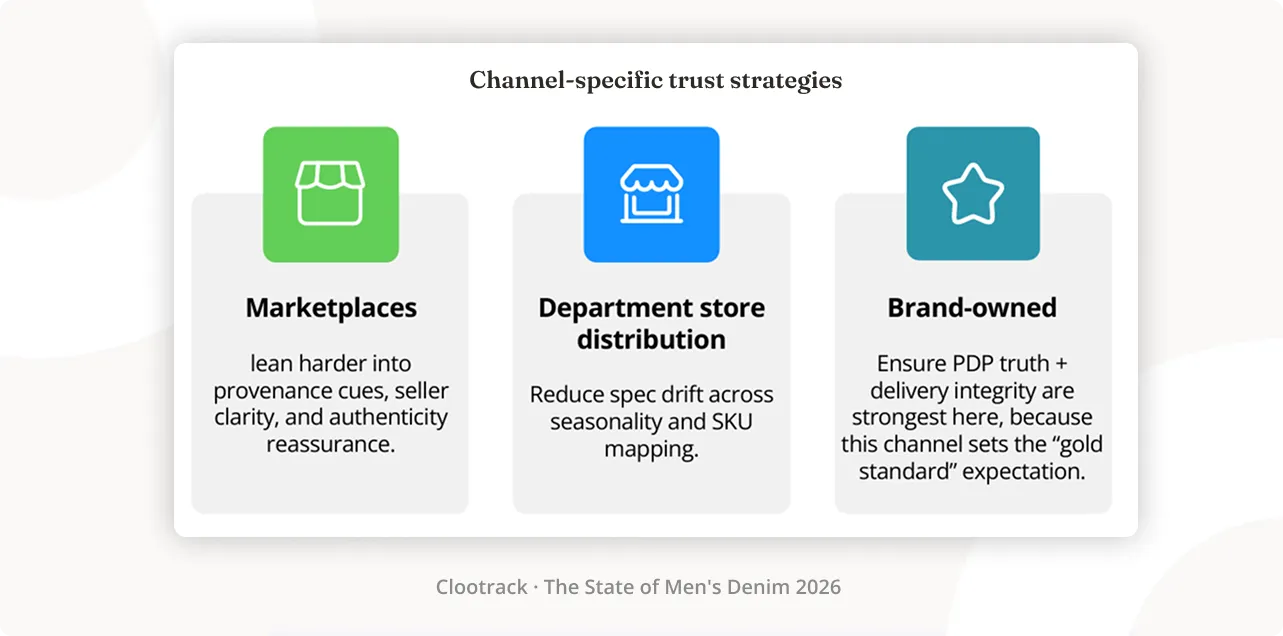
This isn't a CX role recommendations chapter in the usual sense. It's an operating model. Each function gets a named role in the trust chain, a set of specific interventions (not principles), and the KPIs they defend in quarterly reviews. We also bring you three impactful CX protocols that don't exist in most denim organisations today: an integrity fast lane for contamination complaints, a PDP dispute playbook that feeds structured data back to ecommerce, and a size confidence recovery process for repeat buyers who suddenly experience inconsistency.
This chapter contains:
- Function-by-function playbooks for CX, Ecommerce, Merchandising, Consumer Insights, and Ops with specific interventions.
- The "truth checksum" workflow: how to operationalise PDP accuracy so that spec changes automatically trigger imagery, copy, and syndication updates.
- A cross-functional sizing consistency task force; the single highest-leverage initiative in the category.
Key findings
1
CX should own trust restoration & not just ticket closure.
The goal is not to “resolve” the support case and move on. It is to restore confidence after a preventable trust break. That is why CX should own the preventable returns rate, integrity-incident resolution speed, and second-purchase retention after a return.
2
Customer insights only matter when they trigger operating ownership.
A VoC dashboard is not the output. A change is. The useful model here is closed-loop accountability; e-commerce owns Promise, ops owns Proof, CX owns Recovery, merch owns repeatability, and CX insights owns measurement plus follow-through.
3
Some complaints should bypass normal support logic entirely.
Odor, stains, worn items, and “not new” complaints should not sit in a standard queue. They need an integrity fast lane with instant remedy, because customers read them as brand-safety failures, not ordinary service issues.
4
Ecommerce now owns truth, not just conversion.
Once a customer reads the PDP as misleading, the problem is no longer merchandising polish. It is brand credibility. That is why repeated mismatch claims should trigger a truth-check workflow and a PDP lock until the SKU is validated.
Download Report
Thank you! Your submission has been received!
Oops! Something went wrong while submitting the form.
Get the complete denim execution cross-functional playbook
The Money Table capital allocation directive, function-by-function interventions with KPIs, integrity fast lane protocol, and sizing consistency task force design.
Insights report for CX, Ecommerce, Merchandising & Consumer Insights Leaders