
VoC Analysis Report
Seasonality in men's denim
Most denim failures don't arrive as surprises. They arrive on a calendar. January exposes whether a brand's systems are resilient or merely "fine" when demand is smooth, and the cost difference between preparing for it and reacting to it is 2-3x.
Seasonal stress analysis + Operational resilience mapping
AI-driven sentiment analysis tracking how customer experience metrics collapse under seasonal load, and recover after. Mapped against five simultaneous stressors, costed against reactive vs. preventive operating models, and translated into a readiness CX diagnostic.
55,287
Customer reviews
3 Years
Analysis window
U.S.
Market
Executive summary
January is the worst month in men's denim. Positivity falls to 71.6%, negative sentiment peaks at 22.7%, and average satisfaction drops to 3.16. By March, it's back to 76.8%. That shape is the insight. A one-off dip could be noise. A repeatable drop, one that self-corrects in two months, is a systems signal. Something breaks under load every year, in ways customers can feel immediately.
The chapter identifies five stressors that converge in January and shows that brands aren't failing in fashion. They're failing in resilience: the ability to maintain truth and integrity as volume and complexity increase.
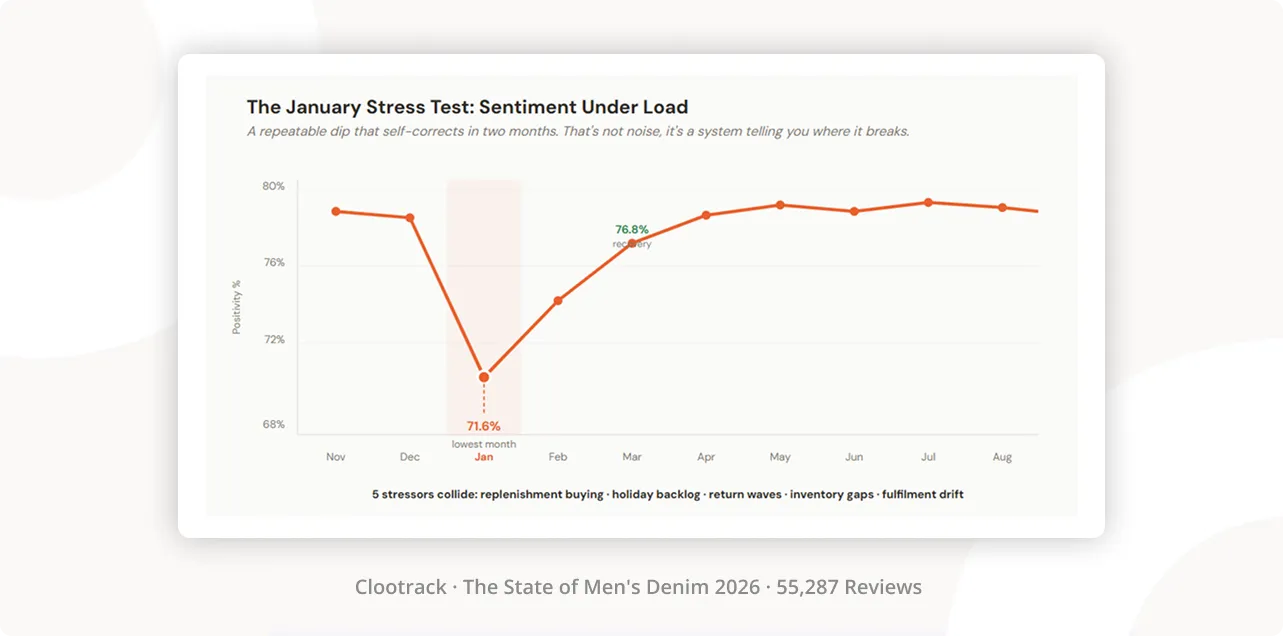
January isn't "post-holiday annoyance." It's the moment five stressors collide simultaneously: replenishment buying plus new-year wardrobe resets, holiday fulfilment backlogs, a return wave with policy friction, inventory discontinuities in core sizes, and QC drift under throughput pressure. When these stack, the customer experience stops being about product preference and becomes more about execution reliability.
This chapter maps:
- Why the January dip is a systems diagnostic, not a seasonal footnote in men’s denim category.
- How availability gaps become return drivers before the box ships; substitution increases sizing uncertainty, which drives bracketing.
- The ROI math on prevention vs. reaction, and why finance structures incentivise the more expensive option.
Key findings
1
Nearly 1 in 4 customer sentiments turn negative in January- the same month, every year.
Negative sentiment peaks at 22.7% while satisfaction drops to 3.16. By March, it self-corrects to 76.8% positivity. That two-month recovery proves this isn't a product problem, it's a load problem. And load problems are fixable.
2
A missing size becomes a return driver before the jeans even ship.
When core "uniform" sizes disappear under January load, the category forces substitution. Substitution in denim isn't neutral; it increases sizing uncertainty and drives bracketing. Availability gaps create returns upstream, not downstream.
3
Customers read restrictive return policies as "the brand protecting itself at my expense."
The post-holiday return wave is where policy design becomes a brand statement. Slow refunds, surprise restrictions, and exchange friction don't read as operational issues to the customer. They read as intent. And that kills brand loyalty.
4
2-3x cheaper to prevent January failures than to react to them
Prevention (1.5x normal cost) shows up as a visible Q4 line item. Reaction (3–5x normal cost + brand damage) gets scattered across seasonal variance. The more expensive option looks cheaper on the P&L. That's why most brands keep choosing it.
Download Report
Thank you! Your submission has been received!
Oops! Something went wrong while submitting the form.
Get the full VoC seasonal stress analysis of men’s denim
Complete customer sentiment mapping, the five-stressor collision framework, reactive vs. preventive cost modelling, and system resilience diagnostics.
Insights report for CX, Ecommerce, Merchandising & Consumer Insights Leaders