
VoC Analysis Report
Reducing retail and e-commerce returns
Denim doesn't fail like a fashion category. It fails like an operating system. Most growth plans invest in the ceiling: campaigns, collabs, new fits, while the floor quietly leaks the compounding part of demand: the second purchase. This chapter is the playbook for fixing the floor first.
Retention leverage vs. acquisition leverage + Voice of Customer (VoC) analysis
AI-driven feedback theme analysis separating operational fundamentals (sizing, delivery, PDP truth, returns) from growth signals (comfort, occasion, body type, style), and explaining why the same ceiling investments behave entirely differently once the floor is stable.
55,287
Customer reviews
3 Years
Analysis window
U.S.
Market
Executive summary
Most denim growth plans are built backwards. They pour budget into acquisition leverage: campaigns, collabs, and new fits, while the retention leverage that actually compounds demand quietly degrades underneath. The data makes the cost of that inversion visible: size consistency sits at 16.5% positivity, delivery condition at 15.5%, and the returns process that's supposed to recover these failures scores 17.5%. These aren't separate departmental problems. They're one integrated trust system, and when any part of it cracks, the customer doesn't isolate the failure. They generalize it to the brand.
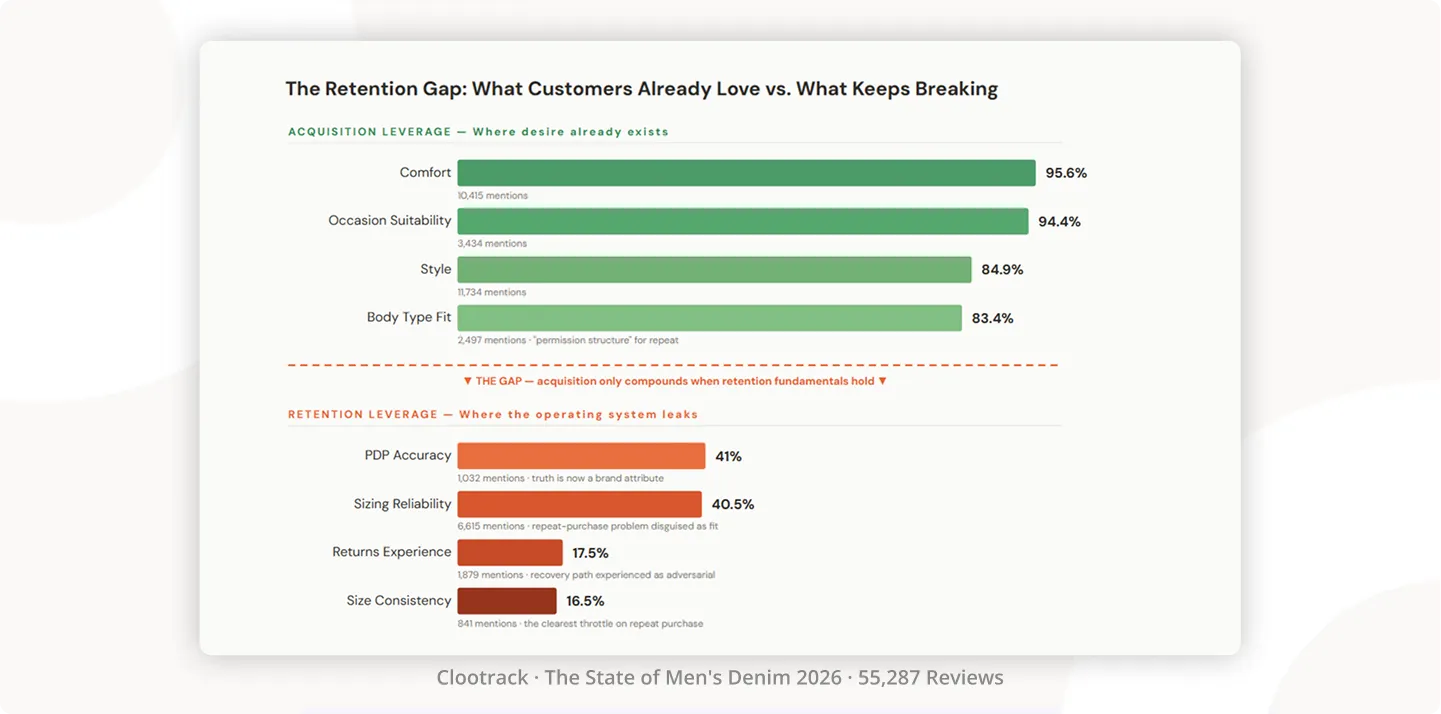
This chapter introduces a floor-vs-ceiling framework that reframes how denim brands should allocate investment. The floor: sizing reliability, delivery integrity, PDP truth, returns recovery, isn't hygiene. It's the compounding engine. When it's unstable, growth converts into volatility: more trials, more returns, and ultimately more distrust. When it stabilises, the same marketing and product investments that previously created trial start accelerating repeat purchases instead.
This chapter maps:
- The four-floor signals and why executive teams lose time treating them as separate departmental problems.
- Two early warning risk signals: odor introducing "health/safety/contamination" framing, and authenticity doubt making customers forensic.
- What happens if you ignore the floor vs. fix it first? Two divergent growth trajectories mapped from the same starting investment.
Key findings
1
Only 16 in 100 denim buyers trust that the same size will fit the same way next time.
The men’s denim category can fit people once. It can't fit them predictably. That gap is why bracketing has become rational, returns have normalised, and the second purchase stays uncertain.
2
Brands can be culturally relevant and still fail to compound.
When the floor leaks, ceiling investments (campaigns, collabs, new fits) drive trial but not retention. Growth turns into a treadmill: more first purchases, more returns, noisier feedback, revocable loyalty. Fix the floor, and the same investments start converting differently.
3
9 in 10 buyers who mention rip and tear resistance in denim are negative about it.
Durability looks decent at the top line (74.3%). Underneath, rip and tear resistance sits at 9.8%, and seam strength at 15.4%. Durability differentiation in 2026 comes from eliminating the harsh failure modes, not from "built to last" storytelling.
4
Body type compatibility isn't a trend. It's a permission structure for repeat purchase.
At 83.4% positivity (2,497 mentions), "this works for my body type" converts uncertainty into identity confidence. But growth here isn't "add more sizes." It's reducing surprise: consistent grading, clearer silhouette outcomes, fit guidance that matches reality across washes and batches.
Download Report
Thank you! Your submission has been received!
Oops! Something went wrong while submitting the form.
Get the full men’s denim CX operating playbook
Complete floor-vs-ceiling framework, four-signal floor diagnostic, legitimate growth signals with strategic implications, early warning risk signals, and the treadmill vs. compounding growth model.
Insights report for CX, Ecommerce, Merchandising & Consumer Insights Leaders