
VoC Analysis Report
How men buy jeans
What actually drives men's denim purchases in 2026, and why the things brands invest in most are the things customers care about least.
Jobs-to-be-done + Decision trigger analysis
AI-driven JTBD and customer feedback theme analysis across 119,417 opinions. Not what customers say they want but a deep-dive into what their behaviour reveals, what they expect from their purchase, and where the category fails the job.
55,287
Customer reviews
3 Years
Analysis window
U.S.
Market
Executive summary
93.9% of men's denim reviews are about functional needs: fit, sizing, quality, and durability. The category delivers on those needs at just 3.8 out of 5. Emotional needs (confidence, identity) and social needs (style, trends) score much higher (4.39 and 4.72, respectively). But they show up in less than 15% of conversations. Brands are investing in what customers barely talk about and under-delivering on what shows up in nearly every review.
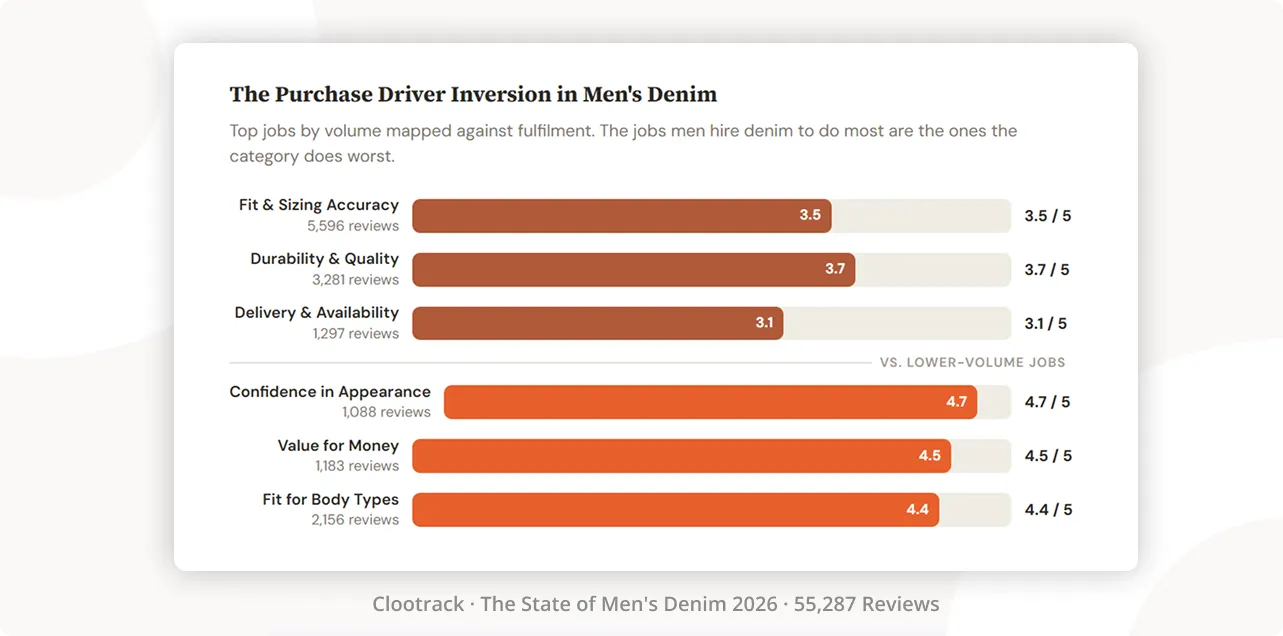
The single largest job in men's denim: “Fit and Sizing Accuracy” accounts for 34.5% of all functional mentions. Its fulfilment score is just 3.48 out of 5. The biggest job, and the worst delivery. Meanwhile, “Delivery and Availability” scores even lower at 3.08 out of 5. These aren't mere customer experience and satisfaction problems. They signal customer purchase confidence problems. And confidence is what decides whether a buyer comes back or quietly exits.
This chapter maps the full men’s jeans purchase decision architecture:
- The five-layer "confidence stack" that every denim purchase runs through.
- Where the stack breaks (and which breaks are fatal vs. recoverable).
- The three-signal exit cascade that turns a repeat buyer into a permanent defector.
The jeans men buy on repeat are the ones where they tolerate the least.
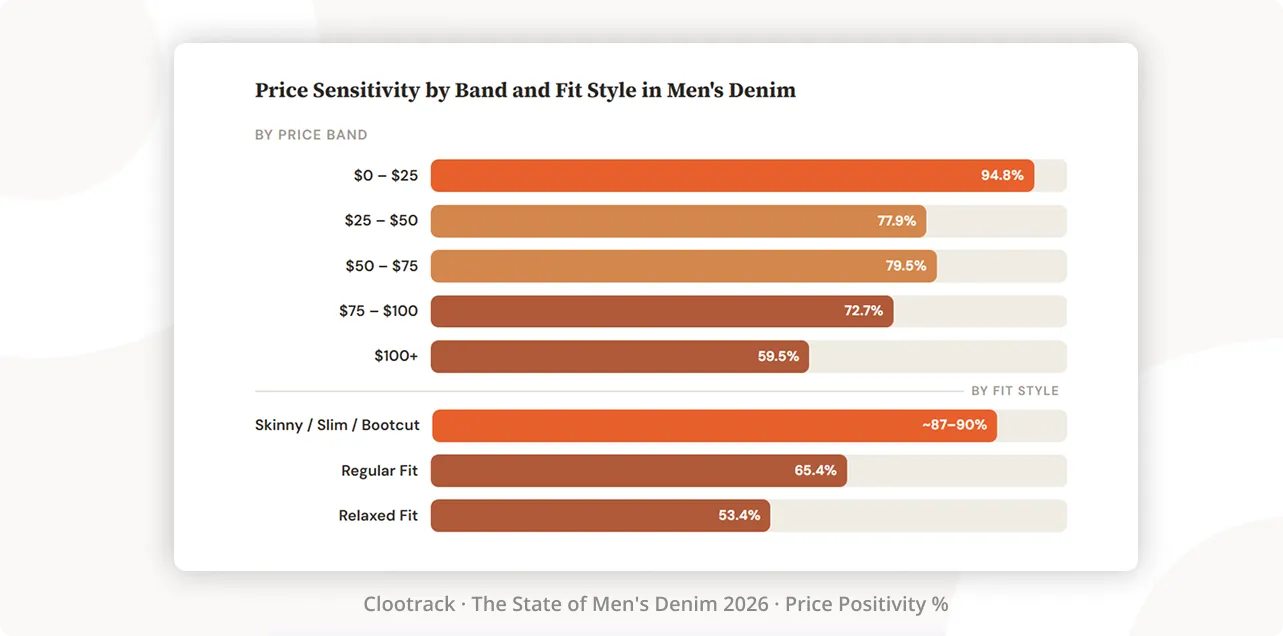
Price positivity by band tells a predictable story. The higher the price, the harsher the judgment. But price by fit style tells a sharper one. Skinny, Slim, and Bootcut, the "fashion" fits, sit at 87–90% price positivity. Regular Fit: 65.4%. Relaxed Fit: 53.4%. That's a 30-point gap. The fits men replenish without thinking are the fits where any change in price, sizing, or quality registers as a betrayal. The replenishment core isn't just the highest-volume segment. It's the most unforgiving.
Key findings
1
Return friction predicts churn better than return frequency.
3 returns with zero friction = loyal customer. 1 return with a policy surprise = lost customer. Customers read return hassle as hostility, not logistics.
2
3.1 / 5 ↓ Delivery & availability fulfilment
The weakest job in the dataset. Availability gaps, misshipped items, and delays lead customers to conclude that the brand's operations can't be trusted.
3
Three variance signals trigger permanent exit.
Signal 1: same size fits different; seeds doubt. Signal 2: PDP mismatch or delivery issue; confirms the pattern. Signal 3: returns friction; triggers exit. By the third, switching is rational.
4
53.4% ↓ Relaxed fit price positivity
Utility buyers who treat jeans like a uniform. Any price, sizing, or quality shift is a contract violation. They don't negotiate; they switch to the cheapest consistent alternative.
Download Report
Thank you! Your submission has been received!
Oops! Something went wrong while submitting the form.
Get the full purchase decision data
Complete JTBD analysis, confidence stack framework, and price-tier dynamics behind every finding on this page.
Insights report for CX, Ecommerce, Merchandising & Consumer Insights Leaders