
VoC Analysis Report
Execution failures driving denim returns
Where e-commerce execution breaks in men's denim, why product pages create more returns than bad product does, and what delivery-condition failures cost brands in lifetime value.
Retail VoC return analysis + E-com trust mapping
Unsupervised AI customer review analysis of how product page inaccuracies, delivery-condition failures, and pricing inconsistencies compound into permanent brand damage. Mapped across channels, prioritized by churn severity, and translated into function-specific action with red-flag thresholds.
55,287
Customer reviews
3 Years
Analysis window
U.S.
Market
Executive summary
Denim customers don't say "bad order." They say "misleading," "counterfeit," "used." That language escalation, from disappointment to moral accusation, is among the central signals in our analysis. It shows up because the details men rely on when buying jeans online are objective and verifiable: fabric composition, stretch percentage, closure type, wash colour, measurements. When any of those are wrong, the customer can prove the brand lied. That creates what we call a "proof event", and proof events are non-recoverable. A fast refund doesn't undo them. It only ends the transaction.
The chapter reveals a compounding failure mechanic: each broken promise doesn't stand alone, it confirms the last one. And the system designed to catch the damage (returns, exchanges, loyalty programs) is actively making it worse.
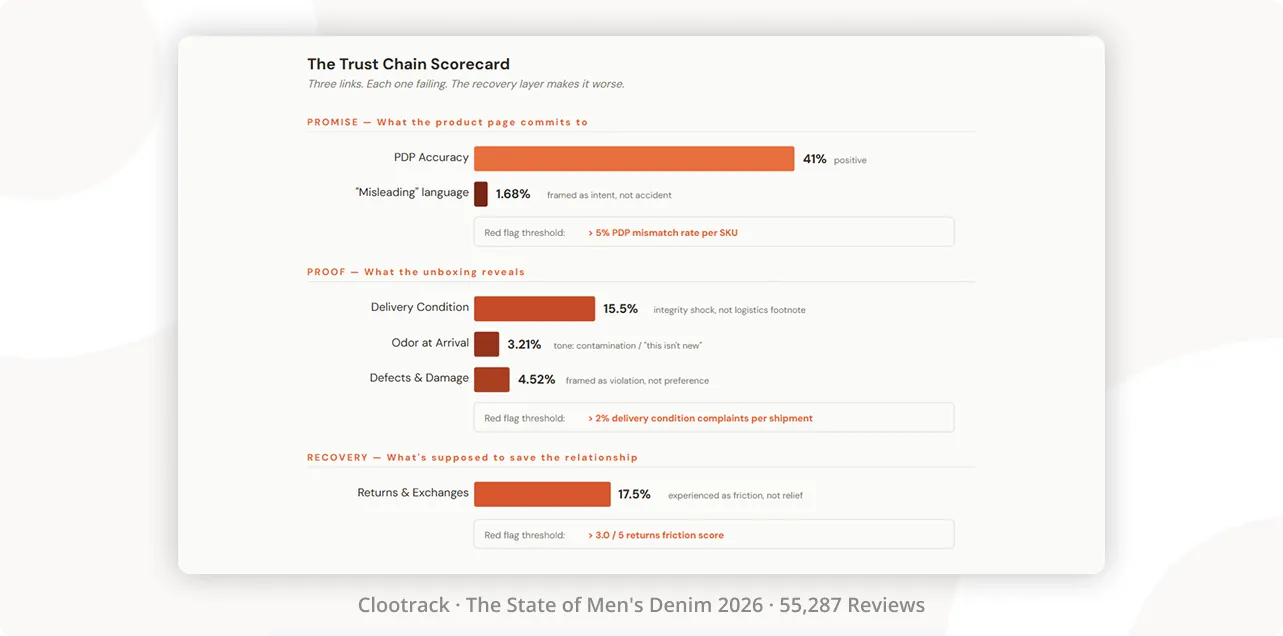
This isn't a customer satisfaction analysis. It's a trust-chain autopsy. The chapter introduces a three-link framework: 1) Promise, 2) Proof, 3) Recovery, and shows that denim e-commerce in the U.S. is failing at all three simultaneously.
This chapter maps:
- The severity hierarchy of PDP mismatches; which ones customers label "errors" vs. which they label "lies," and why that distinction decides churn.
- Why the same failure behaves differently on a marketplace vs. a department store vs. a brand site, and why channel strategy is now trust strategy.
- The hidden cost of vague product pages: sizing uncertainty creates phantom demand through bracketing that inflates volume but obscures real signal.
Key findings
1
4 in 5 denim customers experience the returns process as punishment, not resolution.
Returns & Exchanges scores 17.5% positivity across 1,879 mentions. When the return was triggered by a PDP mismatch in the first place, the recovery attempt doesn't contain the damage. It confirms the original suspicion: this brand doesn't care.
2
98 out of 100 denim buyers who use the word "misleading" mean it as an accusation, not a complaint.
The "misleading" language pocket runs at 1.68% positivity across 119 mentions—near-total rejection. When product images show a brand detail the delivered pair doesn't have, customers don't think "variant." They think "counterfeit."
3
3-4x operational touches hide inside every "true to size" claim.
Vague brand size/fit guidance drives bracket ordering: two sizes in, one back. Merchandising reads those doubled orders as demand. It's not. It's a hedge against a product page that failed to reduce uncertainty, and it makes real volume invisible.
4
9 in 10 buyers accept the denim price. They reject the pricing system.
Price-value positivity runs at 91% (881 mentions). The trust break isn't high MSRP, it's post-purchase price drops, coupon exclusions, and loyalty programs where public deals outperform member deals. When pricing feels arbitrary, buyers use the same word they use for wrong fabric content: "misleading."
Download Report
Thank you! Your submission has been received!
Oops! Something went wrong while submitting the form.
Get the full execution failure data
Complete PDP failure hierarchy with severity tiers, channel-specific risk profiles, pricing trust mechanics, and function-by-function action plans for Ecommerce, Merchandising, and retail Insights.
Insights report for CX, Ecommerce, Merchandising & Consumer Insights Leaders