%201%20(1).svg)
Competitive analysis of U.S. men’s jeans brand perception and consumer switching momentum in 2026

Last Updated:
February 2, 2026

Reading time:
Time
mins
Men’s jeans look like a loyal category, until you read the lines customers leave when something feels “off.” Not the dramatic rants. The quiet stuff: “same size fits different,” “fabric feels thinner,” “quality isn’t what it used to be.” That language is the earliest form of churn. And it’s showing up at scale.
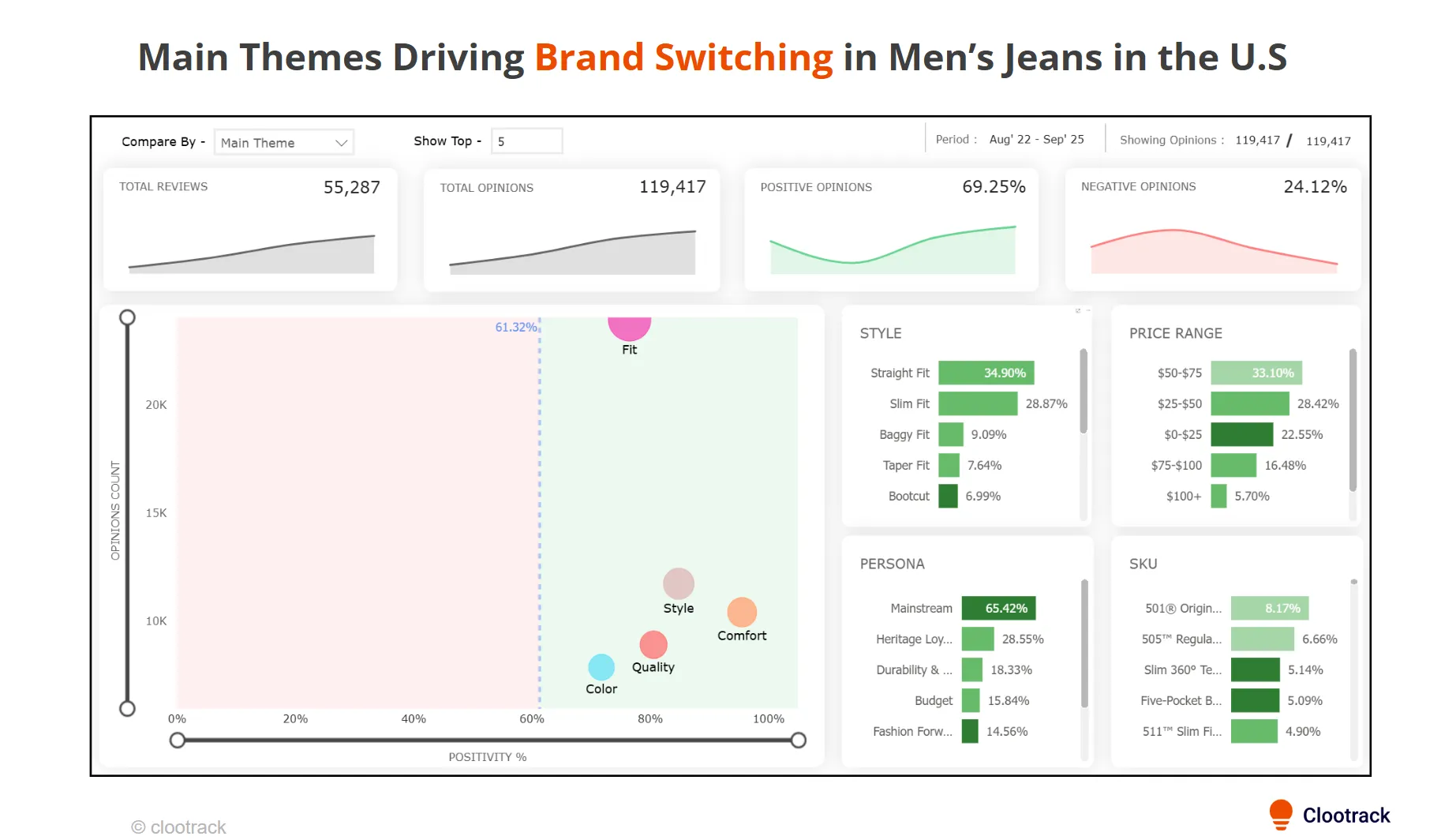
In Clootrack’s latest U.S. men’s jeans Voice of Customer (VoC) analysis study (Aug 2022–Sep 2025), we analyzed 55,287 customer reviews and discussions across Amazon, Target, Walmart, Macy’s, and brand stores, covering Gap, Levi’s, Old Navy, Abercrombie, American Eagle, and Calvin Klein.
We found out that switching momentum is shifting toward brands that combine value, consistent fit, and comfort, and away from brands that can’t protect sizing consistency and durability perceptions.
What is “switching momentum” in men’s jeans, and why does it matter?
Switching momentum is the net movement of customers between brands, measured as Net Flux.
Net Flux = incoming switchers - outgoing switchers.
Why it matters:
- It turns “brand perception” into a measurable outcome: who’s gaining customers, who’s leaking them, and what triggers it.
- It surfaces competitive risk before it shows up in revenue, repeat rates, or return costs.
- It gives teams a single view of the market story (fit, comfort, quality, sizing, durability) rather than competing internal opinions.
In short: Net Flux is your early-warning system for brand defection, and your early proof of competitive pull.
Which men’s jeans brands are gaining switchers right now?
Old Navy and Gap are gaining the most switchers, while Levi’s is losing the most. In the study, Old Navy (+66) and Gap (+65) lead net flux, while Levi’s (-99) shows the strongest negative movement.
That pattern matters because it signals a broader category reset:
- The market is consolidating around fit consistency + comfort + value.
- Legacy share doesn’t guarantee loyalty if fundamentals slip. In fact, the report flags that Levi’s dominates market share but lags in satisfaction, creating an opening rivals capitalize on.
If you’re competing in denim, this is the uncomfortable truth: customers don’t “leave” because of branding. They leave because product basics stopped feeling dependable.

What is actually driving customers to switch jeans brands in the U.S.?
Fit is the primary acquisition lever, followed by price, then quality. For Gap specifically, acquisition momentum is powered by Fit (41% of inbound switches), Price (26%), and Quality (~20%).
Category-wide VoC signals reinforce this:
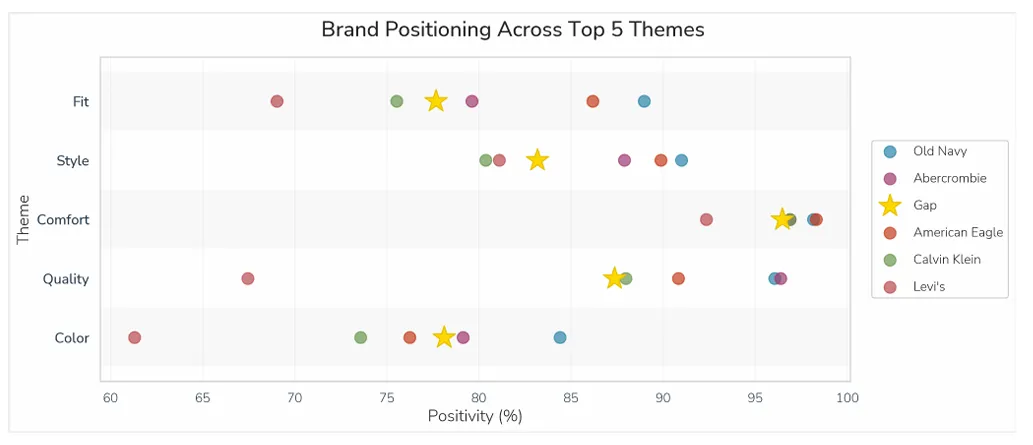
- Fit drives a large share of conversation and is strongly positive (Fit is a top “fundamental”).
- Comfort performs extremely well in sentiment, making it a conversion amplifier when fit is right.
- Brand cues and social proof are increasingly shaping purchase choice, meaning shoppers are using reputation and reviews to “de-risk” fit/quality uncertainty.
This is where a VoC analytics program becomes useful, as it shows you easy-to-miss signals, such as one of the major reasons brand switching occurs is when a competing brand feels safer to buy from online.
What’s the hidden churn engine in denim right now?
Sizing friction and durability concerns are the two biggest silent churn engines because they hit conversion, returns, and trust simultaneously.
From the market dynamics section:
- Sizing remains the weak link with low positivity; waist fit is growing as a complaint signal, while sentiment stays weak.
- Durability is emerging as a purchase driver, but sentiment is mixed, signaling a widening “expectation vs reality” gap.
This is not just a CX issue; it’s expensive. As 82% of shoppers say free returns are an important consideration when shopping online, meaning fit failures don’t just lose margin; they train customers to keep switching.
And consumers keep telling the same story across research: Rithum’s 2025 Global Returns & Profit Impact Report notes that 61% of consumers cite the wrong size/fit as the top reason they returned clothing or shoes, and highlights how expectations vs. reality drives avoidable returns.
How Clootrack’s Voice of Customer analytics platform ran this competitive analysis
Clootrack didn’t “sample” feedback, we analyzed the category at scale using multiple AI agents designed for VoC analytics.
What the platform produced (and what it can produce for any apparel brand):
- Persona extraction (customer segmentation): identifies distinct buyer cohorts based on needs, frustrations, and affinities.
- Theme + subtheme analysis with sentiment: using Clootrack’s patented theme extraction algorithm (reported 98%+ accuracy) to quantify what’s driving satisfaction and dissatisfaction.
- Competitive benchmarking: compares brands on shared themes to expose where you’re ahead, behind, or sitting on whitespace.
- Brand-switch analysis: quantifies switching behavior using Net Flux to surface acquisition drivers and defection risks.
- Jobs-to-be-Done analysis: maps what customers are ultimately trying to achieve (functional + emotional + social), and where brands under-deliver.
This is what “competitive analysis” should mean in apparel: not a deck of opinions; an operating view of what customers reward, what they punish, and where switching is accelerating.
What you can replicate for your apparel brand with Clootrack
If you want this same competitive clarity for your brand, Clootrack can generate:
- A Switching Momentum dashboard (Net Flux by competitor + reasons for switching)
- A Fit and Sizing Risk monitor (waist/size friction signals, trend shifts, and high-impact verbatims)
- A Durability perception tracker (stress-point complaints, fabric quality language, and sentiment drift)
- An Advocacy accelerator view (what customers recommend, and how social proof is compounding)
Request a demo to know more →
FAQs
1. What are the top men's jeans brands by consumer perception in 2026?
Old Navy and Gap rank highest on consumer perception in 2026, driven by consistent fit, comfort, and value. Although Levi’s still leads in market share, it shows weaker satisfaction signals and the highest customer outflow. The data indicates that perception leadership has shifted away from heritage toward brands that deliver dependable sizing and everyday wear reliability at scale.
2. Why do men switch between jeans brands?
Men primarily switch jeans brands due to fit inconsistency, sizing frustration, and declining durability, not branding or campaigns. The Clootrack VoC denim report data shows:
- Fit is the #1 switching trigger, accounting for 41% of inbound switches for gaining brands.
- Price and perceived value follow, especially when fit feels “safer” online.
- Durability gaps (fabric thinning, early wear) quietly accelerate churn.
Switching happens when customers lose trust that the same size will fit the same way next time—creating repeat trial behavior across brands
3. Which men's jeans brand has the highest loyalty?
No men’s jeans brand shows strong unconditional loyalty in 2026. Even historically loyal brands like Levi’s experience high defection rates when sizing and durability slip. Loyalty today is conditional and execution-driven, with customers staying only as long as fit and quality remain consistent. Brands gaining loyalty are those absorbing switchers rather than retaining them long-term.
4. How does fit influence men's jeans brand perception?
Fit is the single most influential factor shaping men’s jeans brand perception. Across the category:
- Fit drives 21.77% of all mentions with strong positivity when consistent.
- Sizing errors (waist variance, inconsistent cuts) show low positivity (~43%), creating distrust.
- Even highly rated brands lose perception equity when “same size fits different” appears repeatedly in reviews.
In short, fit determines whether a brand feels dependable or risky, especially in online purchases where trial costs are high
5. How to analyze competitive perception in men's jeans market?
Brands need to analyze competitive perception using Voice of Customer (VoC) analytics, not surveys or brand tracking alone. The most effective approach combines large-scale review analysis, sentiment by product theme (fit, durability, comfort), and brand-switch tracking using Net Flux. This reveals which brands are gaining customers, which are leaking them, and why, often months before revenue or return data reflects the shift
Share :



Do you know what your customers really want?
Analyze customer reviews and automate market research with the fastest AI-powered customer intelligence tool.