

Clootrack is now officially available as a ChatGPT Plugin
Install now




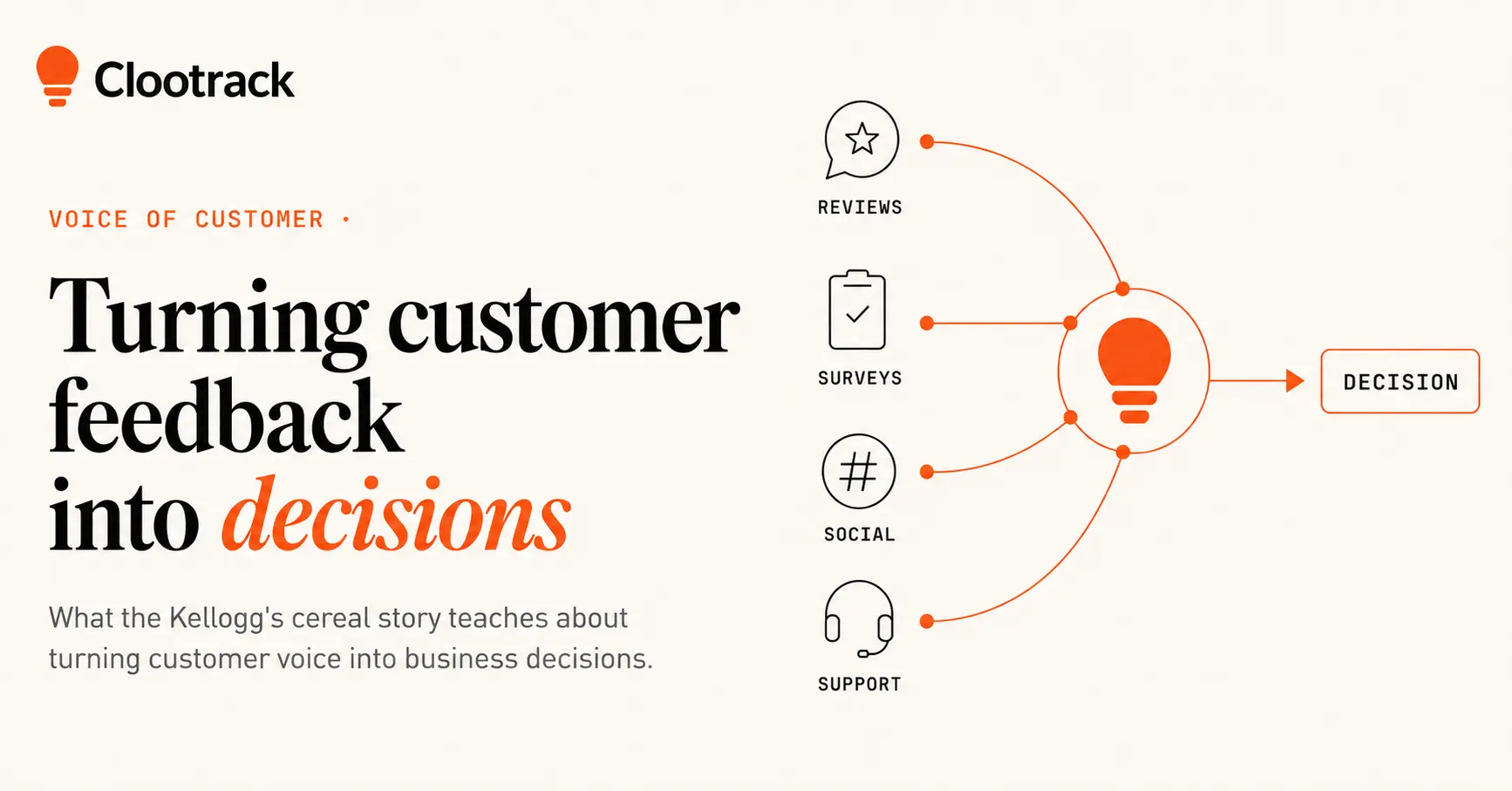
Customer feedback analysis is the practice of collecting customer feedback across reviews, surveys, social posts, and support conversations, then extracting the themes, sentiment, and intent that guide decisions. The Kellogg's cereal brand shows the discipline in action: consumer signals shape product and messaging choices, and those signals move quickly, so brands that read them early can respond on their own terms.
Customer feedback analysis is the systematic process of gathering customer feedback from every channel and converting it into structured themes, sentiment, and priorities that inform product, marketing, and experience decisions. Done well, it turns scattered opinions into a ranked, evidence-backed view of what customers value and what they will not tolerate.
Few names in consumer goods are studied as often as Kellogg's, and its North American cereal business offers a useful lesson in listening to customers. The popular origin tale credits the crisp cornflake to customer demand, though the flake was an 1890s accident the Kellogg brothers later refined for taste. This post uses the Kellogg's cereal case to explain what customer feedback analysis is, why it matters to the business, and how leaders should act on it.
Customer feedback analysis works in four steps: collect feedback from every channel, unify it in one place, analyze it for themes and sentiment, and route the findings to the people who own the decision. The hard part is not collection. It is that most feedback arrives as unstructured text, spread across reviews, contact center analytics transcripts, surveys, and social channels, in language no keyword filter reads cleanly.
That is why Voice of Customer analytics matters. Instead of sampling a few hundred comments, it reads the full body of customer voice, groups it through unsupervised theme analysis, and scores sentiment by theme so leaders see which issues are growing, not just which are loud.
The Kellogg's cereal case shows customer feedback moving from public sentiment to product decisions. After sustained consumer campaigns and a Texas attorney general investigation, WK Kellogg Co, the North American cereal business that was acquired by Ferrero in September 2025, publicly committed to removing FD&C colors from its cereals by the end of 2027, starting with cereals served in schools by the 2026-27 school year. By the company's own account, about 85% of its cereals already contain no FD&C colors.
The context is public and widely reported. The Texas attorney general's office described the signed Assurance of Voluntary Compliance as a first-of-its-kind legally binding agreement, and health advocates had pressed for the change, while the U.S. Food and Drug Administration maintains that its approved color additives are safe. The point here is not the health debate. It is that organized consumer sentiment, visible early in reviews and social conversation, became an input to the product roadmap.
Messaging is the other side of the same skill. In a February 2024 CNBC interview, the company's chief executive suggested cereal as an affordable dinner option for households facing high grocery prices. Coverage noted that the framing drew a strong public response and a boycott call in the following weeks. It is a widely cited illustration of how quickly sentiment can shift around price-sensitive messaging, and why brands read that mood in real time.
It matters because most dissatisfaction never reaches the company as a complaint. Qualtrics XM Institute's Q3 2025 study of 20,001 consumers across 14 countries found that fewer than one in three consumers now give feedback directly, an all-time low. The customers who say nothing still act, so the feedback a brand can see is a small, self-selected slice of the sentiment that moves the business.
The pattern is sharper in packaged food. In Qualtrics XM Institute's data, supermarket experiences carry among the lowest share of sales at risk of any category, so a single disappointing box rarely registers as an immediate spending cut. The real exposure sits at the brand level, in the petitions, reformulation requests, and social conversations that build over time. That is the sentiment the Kellogg's examples turned on, and why reading the full customer voice matters more than counting complaints.
Leaders turn feedback into decisions by answering three questions in order, and answering them per stakeholder: what is important, why did it happen, and what should be done next. The same finding rarely means the same thing to every function, so a single generic recommendation wastes it.
Take rising negative sentiment about artificial ingredients in a cereal line. For the product leader, the action is a reformulation or a cleaner-label extension. For the category and merchandising leader, it is an assortment and pack mix that reflects the shift. For the marketing leader, it is messaging that speaks to the concern directly. For the CX and operations leader, it is closing the loop with the customers who raised it.
That precision depends on evidence breadth. Clootrack reaches these answers by analyzing many data sets together, structured and unstructured, including reviews, surveys, returns, price, and sales data. Combining data types is what gives the conclusion enough credibility to act on, and actionable consumer insights then become decisions with owners.
Best practice is to treat feedback analysis as a continuous discipline, not a quarterly report. The steps that separate signal from noise are consistent across categories:
AI is shifting feedback analysis from manual tagging of samples to unsupervised discovery across the full body of customer voice. Instead of predefining categories and coding a subset, teams surface themes as they emerge and query the data in plain language. Clootrack's Genie lets a leader ask a question of the customer voice directly and get an answer with the underlying verbatims.
The next shift is access. Through governed Clootrack MCP, assistants such as Claude, ChatGPT, and Copilot can reach churn, loyalty, sales, and VoC data under enterprise controls, and AI Decision Digests push the resulting insight to the people who act on it. Scale matters here: Clootrack has analyzed more than 100 billion tokens of Voice of Customer text, a milestone recognized by OpenAI in 2025, the kind of original, attributable evidence that makes a conclusion defensible.
Kellogg's is a useful case study in listening: a cereal brand refined over more than a century toward consumer taste, and a recent example of feedback shaping product and messaging decisions in real time. Customer feedback analysis is no longer a listening exercise. It is a business discipline. The brands that lead read the full customer voice, route it to owners, and act on it early.
See what your customers are really telling you. Analyze customer feedback with Clootrack and turn Voice of Customer into decisions your teams can act on.
Customer feedback analysis is the process of collecting customer feedback across channels and converting it into themes, sentiment, and priorities that inform decisions. It moves a company from reading individual comments to understanding, at scale, what customers value and what drives them to spend less or leave.
It is important because dissatisfaction usually stays silent. Qualtrics XM Institute found fewer than one in three consumers give feedback directly, an all-time low. In packaged food especially, unhappy customers rarely complain, so brand-level sentiment is where the risk shows up. Analyzing feedback fully is how brands see it early.
The main sources are product reviews, surveys, social and community posts, support and contact center conversations, and marketplace ratings. Each reveals something different, from feature-level defects to real-time sentiment to churn triggers. The value comes from unifying them, since no single source represents the full customer voice.
Two widely reported examples show feedback shaping decisions. Kellogg's publicly committed to removing FD&C colors from its cereals by the end of 2027 after consumer campaigns and a state investigation, and its 2024 "cereal for dinner" messaging drew a fast public response. Both point to reading sentiment early and in real time.
Customer sentiment analysis scores the emotion in feedback, positive, negative, or neutral. Customer feedback analysis is broader: it identifies the themes behind the sentiment, ranks them, ties them to business outcomes, and directs action. Sentiment is one input into feedback analysis, not a substitute for it.
AI improves it by reading the full body of feedback instead of a sample, discovering themes without predefined categories, and letting teams query customer voice in plain language. Governed AI access then delivers those insights into the tools and assistants leaders already use, shortening the path from feedback to decision.
No single function owns it, which is the point. The same finding drives different actions for product, category, marketing, and CX leaders. Effective programs route each insight to the stakeholder who can act on it, rather than leaving analysis with one team that cannot fix what it finds.
Share :



Analyze customer reviews and automate market research with the fastest AI-powered customer intelligence tool.
.webp)